
Utility Scale Battery Storage: How It Works, Costs, Uses
Where lithium-ion fits, and the tradeoffs of long-duration alternatives.

- What counts as utility-scale storage in real projects?
- What costs sit outside the battery containers?
- How does LCOS differ from upfront installed cost?
- Which value streams can one storage asset stack?
- Why are most projects built for one to four hours?
- When do non-chemical systems outperform lithium-ion economics?
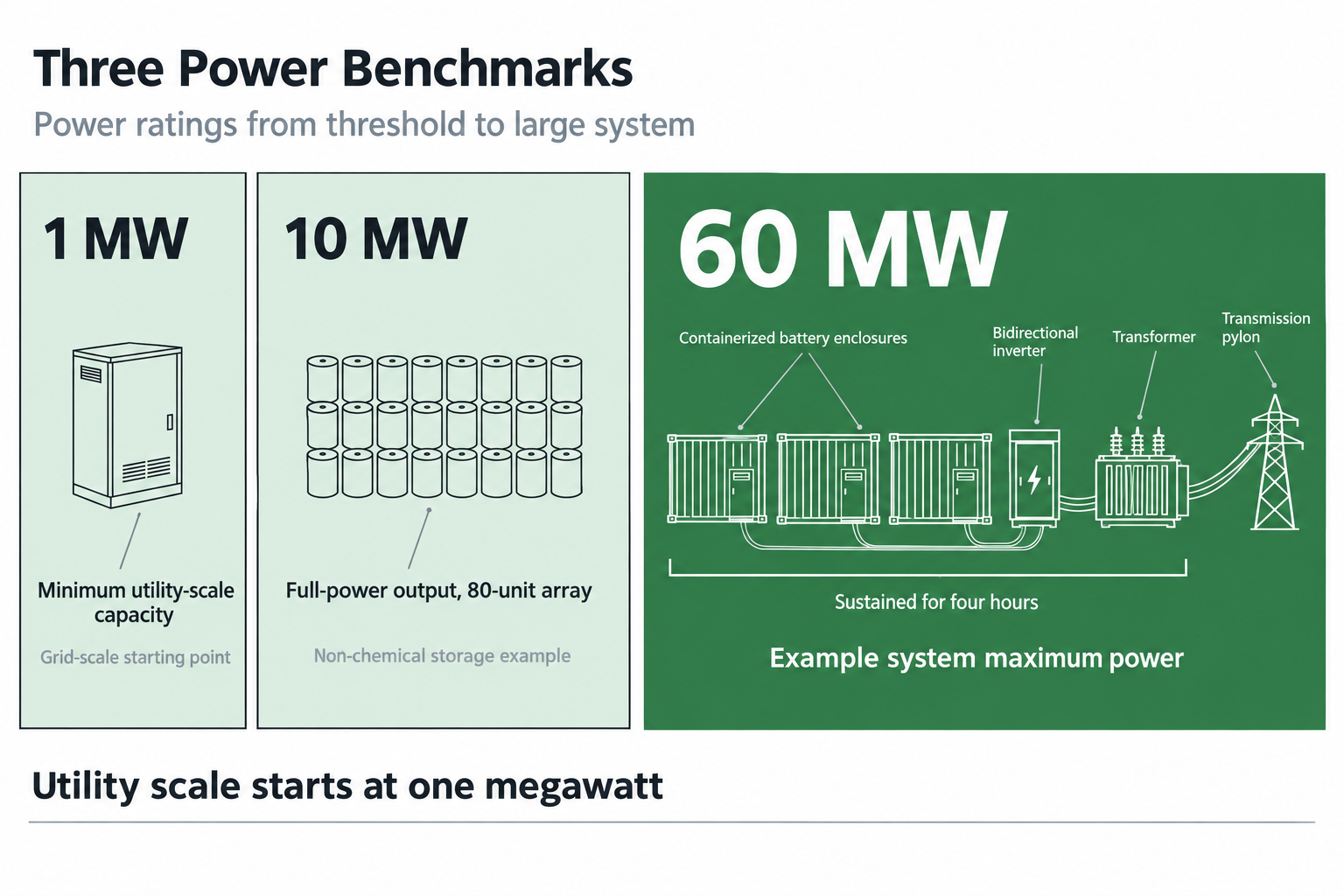
- The U.S. Energy Information Administration defines utility-scale storage as having at least 1 MW of net generation capacity, mostly owned by electric utilities or independent power producers (IPPs) for grid support services.
- Power (MW) and energy (MWh) are different design inputs: a Pennsylvania State University course note states that 60 MW for four hours implies 240 MWh of energy, using duration = MWh divided by MW.
- Bloomberg New Energy Finance reports average lithium-ion pack prices at $115 per kWh in 2024, down from more than $715 per kWh in 2014. Installed utility-scale BESS systems are often benchmarked at roughly $125 to $334 per kWh installed, with the National Renewable Energy Laboratory (NREL) 2025 update using $334 per kWh as a 2024 starting point.
- Policy can shift project economics: standalone energy storage qualifies under §48E, while the full 30% federal investment tax credit generally requires meeting prevailing-wage and apprenticeship rules, with construction starts through 2033 eligible for the full amount (then 75% in 2034, 50% in 2035, and 0 after), and prohibited-foreign-entity sourcing rules applying for construction starts after December 31, 2025.
- Lithium-ion aging is a core constraint: degradation starts on Day 1, projects must be significantly overbuilt at commissioning, and useful life under normal duty is often 7 to 10 years without augmentation (cell add-backs), with about 3% to 5% annual degradation; NREL’s 2025 update also uses a 15-year financial-life assumption when O&M budgets include augmentation to maintain performance guarantees.
- Why Utility-Scale Storage Is Built Now
- What Is Utility-Scale Battery Storage?
- How Does Utility-Scale Battery Storage Work?
- What is the Cost of Utility-Scale Battery Storage?
- What Are the Benefits and Revenue Sources?
- Battery Technology Options and Their Limits
- Qnetic’s Evidence Base for Utility-Scale Storage
- How Qnetic Meets the Long-Duration Utility Storage Definition
- Conclusion
Why Utility-Scale Storage Is Built Now
As grids add more variable renewable generation, storage buildouts are accelerating. A “Today in Energy” update from the U.S. Energy Information Administration reports U.S. utility-scale battery storage has surpassed 26 GW cumulatively. Utility-scale storage is built to turn surplus electricity into dispatchable power when the grid needs it most.
- Intermittency: Solar and wind output rarely matches load.
- Congestion: Storage can relieve constraints at stressed nodes.
- Stability needs: Fast response supports frequency and voltage control.
- Revenue logic: Economics depend on how often the asset can cycle.
What Is Utility-Scale Battery Storage?
The U.S. Energy Information Administration defines utility-scale battery storage systems as having at least 1 MW of net generation capacity. They are typically owned by electric utilities or independent power producers and operated to provide grid support services.
- Grid-connected asset: Built around interconnection, protection, and dispatch.
- Rated in MW: Maximum power the site can deliver at once.
- Rated in MWh: Total stored energy available to discharge.
- Operated by owners: Utilities and IPPs run it for grid services.
Utility-scale battery storage is defined as at least 1 MW of net generation capacity. In practice it is a grid-scale asset rated in MW and MWh that charges and discharges to provide support services.
How Does Utility-Scale Battery Storage Work?
A utility-scale system charges when electricity is plentiful and discharges when the grid needs power or flexibility. In most markets, battery sites are built for 1 to 4 hours because that matches daily peaks and price spreads. A Pennsylvania State University course note explains the sizing logic: a 60 MW battery system with 4 hours of storage can generate electricity at the maximum power of 60 MW for four hours straight. Duration = MWh divided by MW, so 60 MW at four hours implies 240 MWh. Longer duration means more MWh and typically higher cost.
A real-world example is the Moss Landing Energy Storage Facility in California, operated by Vistra, with an original buildout in three phases totaling 750 MW and 3,000 MWh (300 MW + 100 MW + 350 MW). Using the same duration formula, 3,000 MWh ÷ 750 MW equals four hours. After a January 2025 fire, the 300 MW and 100 MW facilities were taken out of service. In Vistra’s Q2 2026 Form 10‑Q, the 300 MW Moss Landing phase was written off, the 100 MW facility was stated as not returning to service, and the 350 MW phase was targeted to return in 2026. Decommissioning has been underway with EPA involvement noted in September 2026, and an additional fire was reported on September 18, 2026.
Some policies define long-duration differently. Virginia SB 448, for example, defines long-duration energy storage as “10 hours or more of generation capacity operating at full nameplate capacity,” with a 4.5 GW target by 2045.
- Battery racks: Store direct current energy with monitoring and safety systems.
- Power conversion: Bidirectional inverters convert between AC grid power and DC storage.
- Energy management: Control software schedules dispatch and enforces operating limits.
- Grid interface: Transformers and switchgear connect safely at grid voltage.
- Supervisory control and data acquisition: SCADA and metering support compliance, settlement, and dispatch.
Non-chemical systems use the same MW and MWh framing, but store energy differently. Qnetic, for example, describes arrays where 80 units deliver 10 MW at full power and 30 MWh of energy at that full-power output, plus a further 10 MWh at reduced power (40 MWh total), depending on operating mode.
What is the Cost of Utility-Scale Battery Storage?
Project economics depend on both component pricing and site-specific costs. Bloomberg New Energy Finance reports that lithium-ion battery pack prices fell nearly 84% from more than $715 per kWh in 2014 to $115 per kWh in 2024. For the full installed system, a utility-scale battery energy storage system (BESS) is often benchmarked at roughly $125 to $334 per kWh installed, with the NREL 2025 update using $334 per kWh as a 2024 starting point; that difference with pack prices reflects balance of plant, engineering, and site work.
In NREL’s Cost Projections 2025 Update, “interconnection” scope is best read as studies and permitting needed to connect and operate a project. It should not be interpreted as including broader grid network upgrades that may be triggered by the interconnection process. The commonly cited low end of ~$125 per kWh varies by scope, and public sources do not provide a consistent, second independent breakdown of what is (and is not) included at that lower bound. Pack price, however, is only one input in a grid-connected project.
- Battery and enclosures: Cells, thermal management, fire safety, and controls.
- Balance of plant: Inverters, transformers, switchgear, cabling, and foundations.
- Interconnection studies and permits: Studies, settings, and permitting; excludes network upgrades.
- Site work: Land preparation, access roads, drainage, and security.
- Operations planning: operations and maintenance, warranties, and replacement strategy over time.
For comparisons across technologies, developers often use levelized cost of storage (LCOS) to relate lifetime costs to delivered energy. LCOS differs from upfront installed cost because it depends on efficiency, usable throughput, and how performance changes over the asset’s life.
Policy can also change project economics: standalone energy storage qualifies under §48E, and the full 30% federal investment tax credit generally requires meeting prevailing-wage and apprenticeship rules. The full credit applies to projects that begin construction through 2033, then phases down to 75% in 2034 and 50% in 2035, and to 0 after that; prohibited-foreign-entity sourcing rules apply for construction starts after December 31, 2025.
What Are the Benefits and Revenue Sources?
Utility-scale storage is valuable because one interconnection can deliver multiple services across different time scales. That multi-service flexibility is the core reason storage shows up in utility planning.
Utility-scale storage earns by delivering distinct services from one interconnection point.
Energy Shifting
Arbitrage by shifting energy between low and peak prices
Capacity Adequacy
Cover peak demand and meet resource adequacy obligations
Peaker Deferral
Delay new peaker plants with reliable peak coverage
Transmission Deferral
Postpone transmission upgrades by relieving constrained corridors
Frequency Regulation
Fast injection and absorption for frequency, reserves, and voltage support
Most sites are designed to stack value streams over the day, but revenue depends on market rules and operational limits. Many lithium-ion original equipment manufacturers [OEMs] rate grid storage for about one cycle per day. That can cap stackable value streams, so it is worth comparing technology options and aging profiles.
Battery Technology Options and Their Limits
Technology choice is a tradeoff between efficiency, footprint, safety profile, and lifetime throughput. In lithium iron phosphate (LFP) BESS projects, a core constraint is aging: degradation starts on Day 1, projects must be significantly overbuilt at commissioning, and useful life under normal duty is often 7 to 10 years without augmentation (cell add-backs), with about 3% to 5% annual degradation. In contrast, NREL’s 2025 update also uses a 15-year financial-life assumption when projects budget O&M for augmentation to maintain performance guarantees. A flywheel energy storage system (FESS) avoids electrochemistry, so its aging and safety constraints are quite different.
| Technology | Typical duration fit | Efficiency note | Aging profile | Practical limits |
|---|---|---|---|---|
| Lithium-ion (LFP BESS) | Hours-scale shifting and grid services | High, chemistry and controls dependent | Day-1 degradation; 3–5%/year; 7–10 years without augmentation | Thermal runaway mode; replacement planning |
| Flow battery | Multi-hour shifting | Lower than lithium-ion in many designs | Low cycle aging in many duty cycles | Larger footprint; system complexity |
| Pumped storage hydropower | Many hours where geography allows | Project dependent | Long asset life | Site and permitting constraints |
| Compressed air energy storage | Multi-hour where geology allows | Project dependent | Long asset life | Geology and system complexity |
| Qnetic flywheel (FESS) | 3 hours full power, 10+ hours derated | Roughly 80 to 88% round-trip efficiency | No capacity fade by design; 30-year design life | Technology is pre-revenue; pilots planned |
For longer-duration needs and heavier cycling, non-chemical storage can change the throughput math. Qnetic describes its flywheel system as a mechanical battery that stores electricity as kinetic energy rather than electrochemistry.
Qnetic’s Evidence Base for Utility-Scale Storage
For emerging storage technologies, procurement decisions usually depend on independent assessment and results from pilots on real grids. Qnetic’s stated path includes an Electric Power Research Institute (EPRI) assessment, sponsored by Sacramento Municipal Utility District (SMUD), with information shared under a non-disclosure agreement (NDA) before scaling to larger projects.
Independent validation and utility pilots for 2027
- Starting point
- Utilities and developers need standards-based evidence before committing to multi-decade storage assets. Datasheets alone rarely support interconnection approvals, protection settings, and long-term revenue underwriting for new technologies.
- Approach
- Qnetic entered EPRI’s assessment program, sponsored by SMUD. EPRI is assessing the technology for eight leading utilities and developers; Qnetic shared its Vega data package under NDA.
- Result
- Two pilots are lined up for 2027: beta units on SMUD’s Sacramento grid starting early 2027, and AI-grade duty-cycle testing with Arevon at the National Lab of the Rockies from mid-2027. Tests are planned, results not yet published.
How Qnetic Meets the Long-Duration Utility Storage Definition
Qnetic positions its flywheel energy storage system as a grid-capable kinetic battery designed for long asset life and heavy cycling. The first commercial product iteration is the Q500, which Qnetic says it is developing as a 500 kWh unit at 125 kW, with no capacity fade by design.
- Throughput focus: Designed to cycle more than once a day.
- Safety profile: No electrochemistry, so no thermal runaway mode.
- Material profile: No lithium or cobalt; neodymium-iron-boron (NdFeB) magnets are sourced from China.
Operationally, Qnetic states that each unit is designed for 3 hours at full power and 10+ hours derated, responding in milliseconds. In other words, the 10+ hour duration applies to derated operation, not full nameplate discharge. As with any pre-commercial technology, performance must be interpreted in the context of ongoing validation and pilots.
Conclusion
Utility-scale storage is commonly defined as storage with at least 1 MW of net generation capacity. Lithium-ion fits many hour-scale duty cycles, but its degradation starts on Day 1 and useful life under normal duty is often 7 to 10 years without augmentation. For heavier cycling and longer-duration targets, non-chemical storage options can change the throughput economics. Qnetic, for example, is developing a flywheel system with design targets that include multi-hour delivery, a 30-year design life, and no capacity fade, as a pre-commercial technology still undergoing validation and pilot testing.
FAQ
How long will a 10 kWh battery power a house?
Runtime depends on your average load. Divide usable energy in kWh by average demand in kW, then adjust for peaks from heating, cooling, and appliances. Using the EIA’s 2022 average of about 10,800 kWh per household per year (~1.2 kW average), 10 kWh usable is roughly eight hours for a whole home, or longer for essential loads only.
Can batteries be used as energy storage systems?
Yes. In a battery energy storage system, batteries store DC energy while inverters and controls manage charging and discharging to the grid. At utility scale, protection, metering, and dispatch telemetry are also required.
How to store random batteries?
Store batteries cool and dry, away from metal objects. Prevent terminal short circuits with caps or tape, keep different chemistries separated, and follow local recycling rules for damaged or swollen lithium cells.
What is utility scale battery storage used for?
It shifts surplus renewable generation into higher-value hours, reduces curtailment, and can provide fast grid services through one interconnection. As a design target, Qnetic is developing flywheel storage without a one-cycle-per-day limit, so the same unit could target both the morning and evening price peaks. The same asset may also support congestion management or capacity obligations, depending on market rules.
How much does a 20 kWh lithium battery cost?
A pack-level reference can be estimated from market-average pack pricing. BloombergNEF’s Battery Price Survey 2025 reports a volume-weighted average of $108 per kWh for 2025, a −8% change versus 2024; at that level, 20 kWh × $108 is about $2,160 for the cell pack only. It is not a price for a purchasable 20 kWh energy storage system: a complete system can cost multiples once you add the inverter, enclosure, installation, and permitting.
What does LCOS mean for utility-scale storage?
Levelized cost of storage averages lifetime costs over delivered energy. It includes capital costs, operations, losses, and throughput, making it useful for comparing technologies with different lifetimes and cycling behavior rather than upfront cost alone.
When does flywheel storage make sense at utility scale?
It fits when a project needs frequent cycling, fast response, and long asset life without thermal runaway risk. Qnetic is developing multi-hour flywheel storage designed for 30 years with no capacity fade by design.


