
Grid Energy Storage: Technologies, Durations, Tradeoffs
Choose storage by duration, duty cycle, and grid services
- What does “duration” mean for grid storage projects?
- When do batteries stop being the best option?
- How do cycling limits change lifetime project economics?
- What safety concerns drive opposition to BESS projects?
- What makes grid-forming inverters different in outages?
- Can mechanical storage avoid battery degradation tradeoffs?
- Grid storage means storing electricity when supply is high or demand is low, then releasing it later to match demand, prevent curtailment, and support stability services like frequency and voltage control.
- The grid needs storage now because variable renewables and fast-changing loads require flexible resources that respond in seconds and shift energy for hours, while transmission buildouts move more slowly.
- No single technology wins everywhere: pumped hydro can be lowest-cost where geography works, batteries dominate short duration, and hydrogen or thermal aim at long duration where efficiency tradeoffs are acceptable.
- “Cheapest storage” depends on use case and duty cycle. The best option will vary depending on use, whether frequency regulation, daily arbitrage, capacity adequacy, or resilience, because cycling limits, augmentation, and financing dominate lifetime cost.
- Qnetic is developing a flywheel-based mechanical battery, the Q500 (500 kWh, 125 kW), designed to deliver for 3 hours at full power and 10+ hours derated, with roughly 80 to 88% round-trip efficiency.
- Grid Storage Has Become a Planning Constraint
- What Is Grid Energy Storage?
- Why Does the Power Grid Need Storage Now?
- What Are the Most Common Grid Energy Storage Technologies?
- Batteries for Grid Storage: Lithium-Ion vs Sodium-Ion
- Short-, Medium-, and Long-Duration Storage Explained
- What Is the Cheapest Way to Store Grid Energy?
- Why Are Some Communities Against BESS?
- Will Grid Storage Keep the Power on During an Outage?
- Experience and Trust: How Qnetic is Building Toward Utility Validation
- How Qnetic Addresses Multi-Hour Grid Storage Gaps
- Conclusion: Pick Storage by Service and Duration
Grid Storage Has Become a Planning Constraint
Wind and solar output can change faster than demand, while new loads can spike unpredictably. As a result, many planners treat grid flexibility as a primary constraint and a core reliability requirement.
A useful way to approach storage is to ask which problem comes first: second-by-second stability, daily energy shifting, or resilience during outages. As a rough planning heuristic, below about 40% variable renewables the grid leans mostly on short-duration flexibility. At around 80% renewables, medium-duration shifting becomes critical. Above 90%, long-duration is typically needed as well.
- Power vs energy: You will see both MW and MWh ratings.
- Duration drives economics: Cost per kWh and sellable services shift with required hours.
- Resilience is separate: Black start and islanding need different controls.
What Is Grid Energy Storage?
Grid energy storage is equipment connected to the power grid that stores electricity at one time and returns it later. It can support multi-hour energy shifting, react quickly for stability, and in some designs help restore service after an outage.
The term covers very different hardware. A grid energy storage battery is one approach, but storage can also be mechanical, thermal, hydro-based, or chemical. In practice, grid operators focus on power rating, usable energy, response, and how performance changes over years.
As of 2023, pumped-storage hydropower remained the largest form of installed grid storage by stored energy (MWh), followed by utility-scale (front-of-the-meter) batteries and then behind-the-meter batteries.
- Power (MW): How much the system can inject at once.
- Energy (MWh): How long it can sustain that output.
- Round-trip efficiency: How much energy returns after losses.
- Duty cycle limits: Whether it can cycle more than once daily.
- Degradation profile: How capacity changes with time and use.
- Interconnection and controls: How it behaves during grid events.
Why Does the Power Grid Need Storage Now?
As renewable penetration rises and conventional synchronous generators retire, the grid needs flexible resources that respond fast and shift energy across hours. The U.S. Energy Information Administration reports cumulative utility-scale battery storage capacity exceeded 26 gigawatts in 2024, in its Today in Energy update published March 12, 2025.
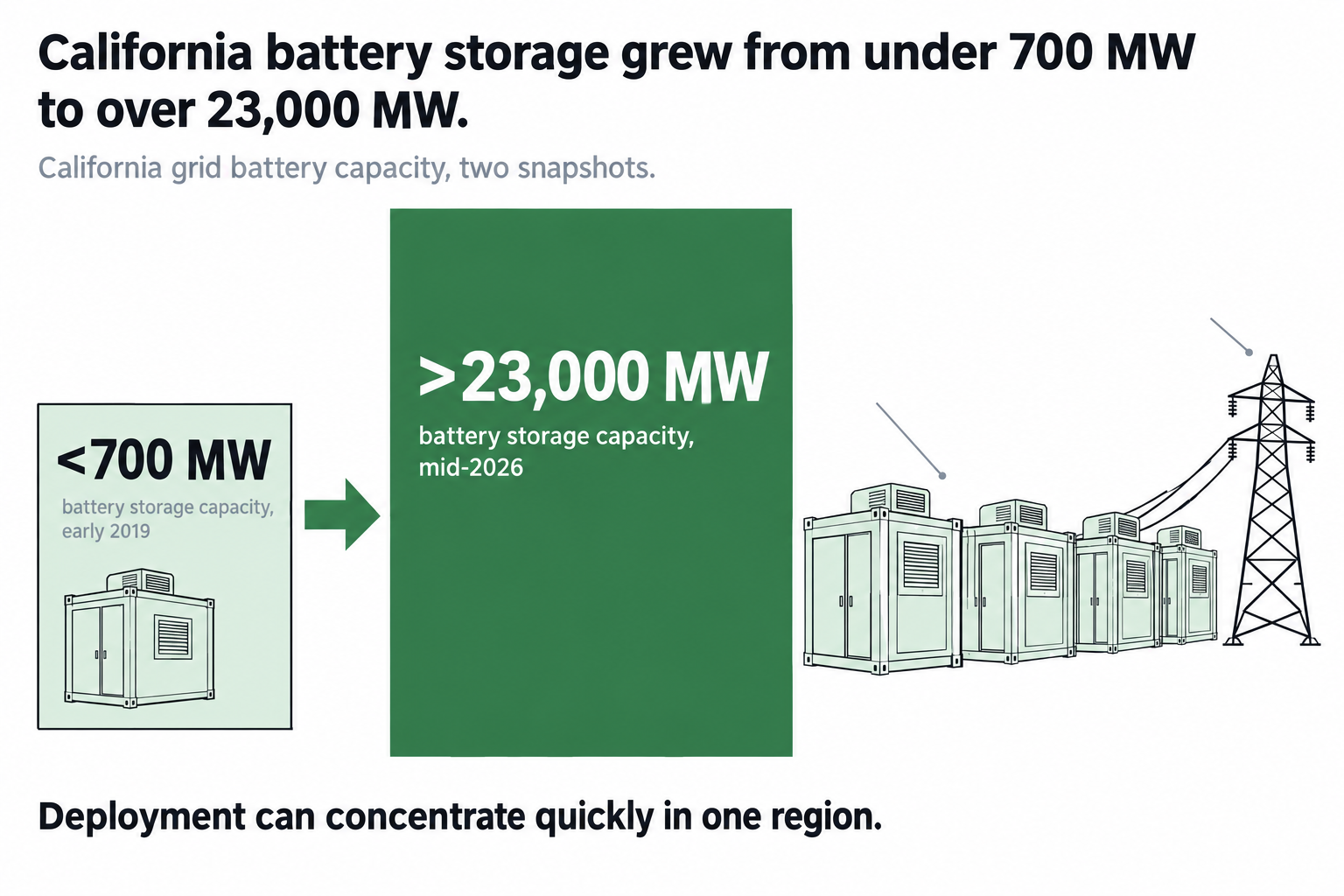
Deployment can also concentrate quickly in specific regions. The California Energy Commission says battery storage capacity grew from less than 700 megawatts at the beginning of 2019 to more than 23,000 megawatts by mid-2026.
- Supply-demand balancing: Storage covers ramps within minutes.
- Renewables smoothing: It reduces short-term output volatility.
- Peak shaving: It reduces the highest net-load hours.
- Curtailment reduction: It absorbs excess generation that would be wasted.
- Ancillary services: It provides frequency response and voltage support.
- Transmission deferral: It can relieve congestion while power line builds take years.
What Are the Most Common Grid Energy Storage Technologies?
Grid-scale storage spans multiple technology families with different tradeoffs. The most practical way to compare options is by duration fit, efficiency profile, site constraints, and how performance changes with age.
| Technology | Typical duration fit | Typical efficiency profile | Grid-scale maturity | Strengths | Practical constraints |
|---|---|---|---|---|---|
| Pumped-storage hydropower | Multi-hour to long duration | Roughly 70 to 85% | Mature, large installed base | Long life, large energy blocks | Geography, permitting, long timelines |
| Battery energy storage systems (BESS) | Short to medium duration | About 90% (LFP) | Fast-growing | Fast response, modular siting | Degradation planning, safety design, augmentation |
| Compressed air energy storage (CAES) | Medium to long duration | About 65% | Limited deployments | Long duration potential | Geology, complex balance-of-plant |
| Thermal energy storage | Medium to long duration | Project-specific | Emerging to growing | Low-cost materials possible | Application-specific, heat-to-power penalties |
| Hydrogen (power-to-gas-to-power) | Long duration to seasonal | Lower end-to-end | Emerging | Very long duration, cross-sector use | Conversion losses, infrastructure complexity |
| Flow batteries (vanadium redox flow) | Medium duration | About 65% | Limited deployments | Independent energy and power scaling | Lower efficiency, shorter life vs pumped hydro |
| Conventional flywheels | Short-duration grid services | High for short bursts | Niche at grid scale | Very fast response, high cycle count | Typically not designed for multi-hour shifting |
| Qnetic flywheel FESS (in development) | 3 hours full power, 10+ hours derated | Roughly 80 to 88% | Prototype to planned pilots | Multi-hour mechanical storage, no thermal runaway | Not yet shipping commercially; pilots planned for 2027 |
For service stack planning, a Flywheel Energy Storage System (FESS) is best assessed by the grid services it can sustain. If the job is daily shifting, lifetime performance and cycling limits often outweigh nameplate specifications.
Batteries for Grid Storage: Lithium-Ion vs Sodium-Ion
Batteries dominate many new builds because they are modular, respond quickly, and integrate cleanly with modern power electronics. For planners, though, “battery” is not one thing. Supply chains, safety behavior, and aging over time can drive more risk than the initial procurement.
Lithium-ion—especially lithium iron phosphate (LFP), the dominant lithium-ion chemistry in grid storage—remains the default in many regions. Typical grid batteries are built for about 1 to 4 hours of discharge, but the lifecycle economics depend on how the system is dispatched. Qnetic’s view of lithium-ion is this: degradation starts on Day 1, projects must be significantly overbuilt at commissioning, and useful life under normal duty is 7 to 10 years.
Lithium-Ion
- Large manufacturing scale supports bankability
- High efficiency suits short-duration shifting
- Mature inverters and controls ecosystem
- Degradation requires augmentation and replacements
- Fire safety drives permitting complexity
Sodium-Ion
- Abundant feedstock can ease bottlenecks
- Lower energy density than lithium-ion; less limiting stationary
- Generally less prone to thermal runaway
- Supply chain is earlier-stage
- Performance is still product-specific
Chemistry selection does not remove grid constraints. Interconnection limits, dispatch rules, and revenue stacking often decide whether the project performs as modeled.
Short-, Medium-, and Long-Duration Storage Explained
Choosing the right duration is the simplest way to avoid category mistakes. A system that is excellent at second-by-second stabilization is not automatically suited to multi-hour shifting, and a long-duration design can be the wrong tool for fast services. Clear duration definitions also matter in policy and cost targets.
Compare solutions for grid storage by duration first; it quickly reveals fit, risk, and economics.
Short Duration
Seconds to 2 hours, stabilizes frequency and ramps.
Medium Duration
2 to 10 hours, shifts solar and peaks.
Long Duration
10+ hours, covers lulls and capacity adequacy.
Qnetic positions its flywheel as a mechanical battery designed for multi-hour discharge: 3 hours at full power and 10+ hours derated, with no capacity fade over a 30-year design life.
What Is the Cheapest Way to Store Grid Energy?
“Cheapest” depends on the job: frequency response, daily energy shifting, capacity adequacy, or resilience. Installed cost per kilowatt-hour can be misleading, because financing, duty cycle, and replacement planning often dominate lifetime cost.
- Pumped-storage hydropower: Largest installed storage by stored energy (MWh); often lowest cost where the geography is suitable.
- Lithium-ion: Costs often fall around 20% per doubling of capacity.
- Demand response and interconnection: Sometimes cheaper flexibility than new storage.
For utility-scale 4-hour battery systems, the National Renewable Energy Laboratory (NREL) reports cost projections of $152/$247/$349 per kWh in 2035 and $111/$184/$333 per kWh in 2050 (low/mid/high cases). The values are shown in that cost-projections publication.
For a standalone 1-MW/4-MWh battery system in India, Lawrence Berkeley National Laboratory reports bottom-up capital cost estimates falling from $203 per kWh in 2020 to $134 per kWh in 2025 and $103 per kWh in 2030, in inflation-adjusted (real) 2018 dollars.
- Start with the service: Define the revenue stack first.
- Match duration to value: Overbuying duration dilutes returns.
- Plan for aging: Augmentation can dominate lifetime cost.
- Model cycling limits: Dispatch rules change economics.
- Account for grid constraints: Interconnection can cap value.
- Separate resilience budgets: Backup duration and grid-forming add cost; budget them separately from arbitrage.
Why Are Some Communities Against BESS?
Opposition to BESS projects often centers on fire safety, siting impacts, and uncertainty about lifecycle costs and ratepayer impacts. In many communities, the core concern is risk management and how those risks are governed.
- Fire risk: Thermal runaway events drive local resistance.
- Siting impacts: Industrial installations located near neighborhoods face scrutiny.
- Permitting friction: Requirements can become stricter after incidents.
- Lifecycle questions: Replacement frequency and end-of-life disposal can be contentious.
- Trust gap: Overpromised performance can create skepticism.
Mechanical storage aims to address part of that debate by removing concerns about electrochemistry. Qnetic is developing a flywheel-based approach with zero probability of thermal runaway and layered protection concepts; formal UL 9540 certification — a U.S. safety standard for energy storage systems that permitting authorities often require — is anticipated but has not yet been completed.
Will Grid Storage Keep the Power on During an Outage?
Storage can support resilience, but only if the system is engineered and permitted for that role. A merchant project built mainly for wholesale arbitrage may not be configured to energize a dead circuit. Most grid batteries are 1-to-4-hour systems at rated power, which falls far short of storm-driven outages that can last for days. The key control distinction is grid-following versus grid-forming inverter behavior.
Grid-following inverters need a reference voltage and frequency. Grid-forming inverters can establish that reference, which supports islanded operation in microgrids and, in some designs, restoration sequences. Separate from inverter mode is black start, which depends on protection and step-by-step restoration plans.
- Not all storage is backup: Resilience requires specific controls.
- Grid-forming capability: It can establish voltage and frequency.
- Black start design: Restoration is engineered and tested.
- Duration must match events: Short systems are not multi-day backup.
- Protection rules apply: Interconnection settings govern what is allowed.
- Operational plans matter: Dispatch must align with outage roles.
Experience and Trust: How Qnetic is Building Toward Utility Validation
Grid storage buyers commit capital over decades, so trust is built through independent assessment and live pilots. Qnetic is early-stage, but it is organizing validation around utility sponsors and recognized test pathways such as the Electric Power Research Institute (EPRI), which is often the gating item for procurement.
Independent validation and utility pilots for 2027
- Starting point
- Utilities need standards-based evidence on a live grid before committing multi-decade budgets to new storage hardware. Data sheets and lab claims rarely carry decisions over decades of service without independent assessment.
- Approach
- Qnetic entered EPRI’s technology assessment pathway, sponsored by Sacramento Municipal Utility District (SMUD). EPRI is assessing the technology on behalf of eight leading utilities and developers, and Qnetic shared its Vega prototype data package with EPRI under a non-disclosure agreement.
- Result
- Two utility-scale pilots are lined up for 2027: beta units on SMUD’s Sacramento grid and AI-grade duty-cycle testing with Arevon at the National Lab of the Rockies. The work is scheduled and not yet published as results.
How Qnetic Addresses Multi-Hour Grid Storage Gaps
Daily shifting needs storage that can discharge for hours, respond quickly, and keep economics stable over a long asset life. The hardest part is that revenue often depends on cycling flexibility, while many battery projects must plan for performance loss and augmentation over time.
Qnetic is developing a Flywheel Energy Storage System with the Q500 planned first, reaching 10+ hours of discharge (at derated power).
- Mechanical storage: Designed to shift energy for hours.
- Cycling flexibility: Not limited to one cycle per day.
- Lifecycle focus: Targets long asset life without capacity fade.
Commercialization is planned beginning in 2028.
Conclusion: Pick Storage by Service and Duration
Grid storage projects succeed when the technology is chosen for the service stack: fast response, daily shifting, capacity adequacy, or resilience. Pumped hydro can dominate where sites exist, batteries lead short-duration deployment, and long-duration options trade efficiency for coverage.
A practical shortlist is duration class, duty cycle, degradation behavior, inverter mode, and interconnection constraints. When those are clearly known, procurement risk drops and performance is easier to validate against real dispatch needs.
FAQ
What is a grid energy storage system?
A grid energy storage system stores electricity and returns it later to match demand, reduce curtailment, and provide grid services. It can be built from batteries, pumped hydro, compressed air, hydrogen, thermal storage, or mechanical systems. Qnetic is developing a flywheel energy storage system as one mechanical option.
Why are people against BESS?
Opposition usually centers on safety concerns like thermal runaway, siting impacts, and uncertainty about lifecycle costs. Communities also question whether a project is designed for resilience or mainly for market arbitrage and revenue stacking.
Will batteries work if the grid goes down?
They can, but only if the system is designed for islanded operation and permitted under interconnection rules. Grid-following inverters need a live reference, while grid-forming inverters can establish voltage and frequency.
What does “duration” mean for grid storage projects?
Duration describes how long a storage system can deliver its rated power before it is depleted. For example, Qnetic’s Q500 is designed for 3 hours at full power, which at 125 kW corresponds to about 375 kWh (3 hours × 125 kW). The remaining ~125 kWh is available only at reduced power, which is why the unit is described as 10+ hours derated. At array scale, Qnetic describes 80 units delivering 30 MWh at 10 MW full power plus a further 10 MWh at reduced power (40 MWh total).
What is the cheapest way to store grid energy?
Pumped-storage hydropower is often the lowest-cost large-scale option where geography allows, and demand response plus stronger interconnection can sometimes be cheaper flexibility than building new storage; lithium-ion costs also tend to fall about 20% per doubling of installed capacity. For 4-hour battery systems, the National Lab of the Rockies (formerly NREL) shows $152/$247/$349 per kWh in 2035 and $111/$184/$333 per kWh in 2050 (low/mid/high cases).
How do cycling limits change lifetime project economics?
Cycling limits change how much energy a project can deliver over its life and how much revenue it can earn. If aging restricts cycling, projects may need augmentation or earlier replacements, raising lifetime cost.
Can mechanical storage avoid battery degradation tradeoffs?
Mechanical storage avoids electrochemistry, so it can reduce fire risk and eliminate certain battery aging mechanisms. Qnetic is developing a flywheel-based mechanical battery designed for multi-hour discharge with no capacity fade by design.


