
Flywheel Energy Storage: How the Kinetic Battery Stores Electricity
How a spinning rotor takes in power and gives it back within seconds

- What is flywheel energy storage, exactly?
- How does a flywheel store electricity as rotational energy?
- Which components make up an industrial flywheel energy storage system?
- Where are flywheel storage systems used on the power grid?
- How does flywheel energy storage compare with lithium-ion?
- A flywheel energy storage system stores electricity mechanically, as the rotational energy of a fast-spinning rotor, with no chemistry, no lithium and no cobalt. It does what a battery does, but mechanically.
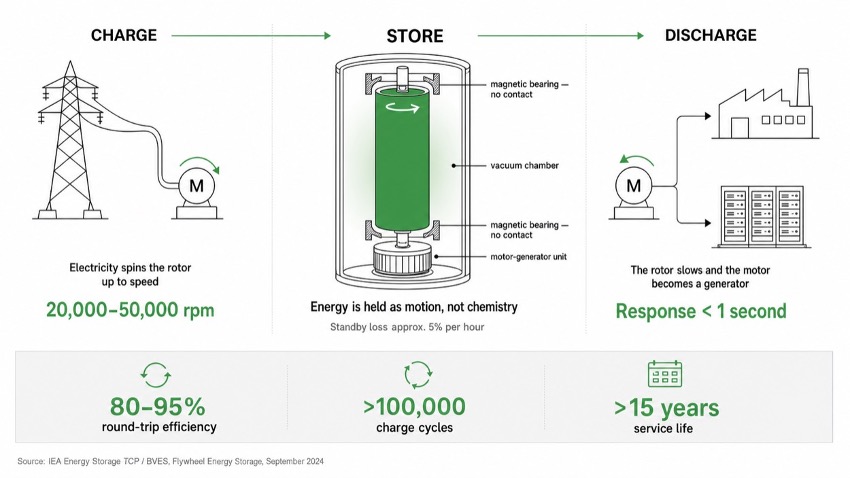
- When charging, a motor-generator spins the rotor up to tens of thousands of revolutions per minute, up to 50,000 depending on the design. When discharging, the same motor brakes the rotor and turns the motion back into electricity.
- Conventional flywheels deliver energy over seconds to minutes and suit frequency regulation, grid stabilization and regenerative braking, not the home battery behind a rooftop solar array.
- Against lithium-ion, the technology scores on long service life, high cycle counts and fire safety, no degradatio.
- Qnetic’s launch product, the Q500, is a flywheel energy storage device 125 kW of power and up to 500 kWh of usable energy, depending on duty cycle. A future variant, the Q1, is planned at 1 MWh.
- Why a spinning wheel becomes a power storage system
- What is a flywheel energy storage system?
- How does flywheel energy storage work?
- What components make up a flywheel storage system?
- Flywheel energy storage applications: where the technology is used
- Flywheel battery vs. lithium-ion: the storage comparison
- Advantages and limits of flywheel energy storage technology
- Flywheel solar energy storage and long-duration: is it worth it?
- Our experience with flywheel storage at Qnetic
- Why Qnetic is rethinking flywheel energy storage
- Conclusion
Why a spinning wheel becomes a power storage system
Electricity does not have to be locked into chemistry. It can also be stored in motion. That is exactly what flywheel energy storage does: it accelerates a heavy mass to high speed and holds the energy as rotation. When the power is needed, the system brakes the rotor and returns the energy to the grid.
The idea is old, but it is having a revival. The reason: according to estimates, the energy transition needs a hundred times today’s storage capacity, and lithium-ion batteries have real weaknesses. They age, they degrade with every cycle, and their supply chains hang on a handful of raw materials. in extreme cases they burn. Flywheels sidestep many of these problems and deliver power in milliseconds across well over 100,000 cycles.
Flywheel storage is no cure-all, but for certain jobs it is the technically superior choice. And modern approaches are moving the limit of what mechanical storage can do.
- A clear definition of the kinetic battery and how it differs from chemical storage
- The charge and discharge process explained step by step
- The four core components and the main fields of use
- A fact-based comparison with lithium-ion and ultracapacitors
- Advantages, limits and the question of whether flywheels pay off for solar
What is a flywheel energy storage system?
A flywheel energy storage system (FESS) is a mechanical store for electricity that holds electrical energy as the rotational energy of a fast-spinning mass. Instead of shuttling ions inside a battery cell, the system accelerates a rotor and keeps the energy in its motion. That is why these systems are also called kinetic energy storage systems or mechanical flywheel energy storage, and in plain terms a kinetic or mechanical battery.
The difference from chemical storage is fundamental. A lithium-ion cell binds energy in an electrochemical reaction that loses a little capacity with every cycle. A flywheel has no such chemical wear. The energy sits in the physics of rotation, and physics does not age. That is why flywheel energy storage is often described as a degradation-free alternative.
Modern systems use a rotor made of carbon fiber composite rather than solid steel. Because the stored energy quadruples when the rotation speed doubles, a light, fast flywheel energy storage rotor outperforms a heavy, slow one. Qnetic’s carbon fiber rotor design reaches roughly six times the energy density of a steel rotor, allowing for a lighter rotor that can spin at high speeds.
- Storage principle: the energy sits in the rotation of a mass, not in a chemical reaction
- Design: a single moving part levitating in a vacuum, instead of thousands of cells filled with electrolyte
- Scale: the Qnetic Q500 is specified at 500 kWh and 125 kW, with a 1 MWh variant on the roadmap
- Versus the capacitor: a flywheel holds energy for hours, an ultracapacitor only for seconds
- Deployment size: grid scale rather than single-family home, so MWh instead of kWh
How does flywheel energy storage work?
Flywheel energy storage works on a simple principle: power in means spinning faster, power out means slowing down. The motor-generator runs in both directions and handles the conversion between electrical and kinetic energy. In between there is only motion, no chemical intermediate step.
The flywheel energy storage mechanism breaks down into clear steps. At Qnetic the rotor spins inside a vacuum chamber, which all but rules out air friction and helps minimize the self-discharge losses. The Q500 can store energy for several weeks.
-
Take in power
Grid power flows into the system’s motor-generator. -
Spin up the rotor
The motor drives the rotor to high speeds. -
Hold the energy
In a vacuum, the rotor keeps spinning almost friction-free. -
Brake the rotor
On demand the motor acts as a generator and brakes. -
Release power
The motion is converted back into grid power.
Response time is in the millisecond range, under three milliseconds at Qnetic. That speed makes flywheels interesting wherever instant power matters.
What components make up a flywheel storage system?
Four components make up a flywheel energy storage system.
Only their interplay keeps the rotor moving almost without friction and turns a spinning mass into controllable electricity storage.
Rotor
The spinning carbon fiber mass stores the kinetic energy.
Motor-generator
Converts power into motion and motion back into power.
Magnetic bearings
The rotor levitates without contact, friction or lubrication.
Vacuum enclosure
Nearly airless, it minimizes drag and standby losses.
At Qnetic, the motor-generator carries the internal name “Genmo”, and active as well as passive magnetic bearings keep the rotor levitating without contact, with no lubrication and no wear part that has to be swapped out after a few years. Exactly this combination of carbon fiber, magnetic bearings and vacuum forms the technical basis on which Qnetic builds the Q500.
Flywheel energy storage applications: where the technology is used
Industrial flywheel energy storage systems, meaning flywheels built for grid and plant duty, pay off where power is called on within seconds and very frequently.
Five fields of use shape practice today, from frequency regulation to the AI data center.
Frequency regulation
Response within seconds reliably stabilizes grid frequency.
Grid stabilization
Buffers swings in grids with high solar and wind shares.
Regenerative braking
Stores braking energy from trains and rail vehicles.
Charging infrastructure
Strengthens local grids at EV fast-charging stations.
Data centers
Buffers high-frequency load peaks from AI data centers.
What is missing from this list stands out: shifting large amounts of electricity over several hours. That gap is why flywheels still count as a niche technology, and it is where Qnetic starts. For AI data centers the company can pair its storage with lithium-ion in hybrid systems, extending the life of the lithium batteries, thereby providing greater overall value to customers.
Flywheel battery vs. lithium-ion: the storage comparison
Whether a flywheel for energy storage pays off only becomes clear in a direct comparison with the alternatives. A flywheel battery, a lithium-ion cell and an ultracapacitor each occupy a different niche, and on service life, cost and energy density worlds separate them. Conventional flywheels sit between the ultracapacitor and the battery: high cycle counts, but higher storage costs and lower energy density.
The table below sets the technologies side by side and shows where the Qnetic approach moves the usual flywheel limits. The three left-hand columns give values for systems available on the market, the Qnetic column the design values of the Q500, which is currently in prototype validation ahead of commercial deployment. The last row shows LCOS (levelized cost of storage), the average storage cost per kilowatt-hour across the full service life.
| Criterion | Conventional flywheel | Lithium-ion (LFP) | Ultracapacitor | Qnetic Q500 |
|---|---|---|---|---|
| Service life | 15+ years | 7-10 years | 10–15 years | 30 years |
| Cycles | 100,000+ | 3,000-5,000 / limited to 1/day | very high | 22,000+, no daily limit |
| Degradation | none | 3-5%/year | low | zero |
| Discharge duration | seconds – minutes | hours | seconds | hours |
| Fire risk | none | present | none | none |
| LCOS 2030 | high | ~$164/MWh | very high | ~$101/MWh |
On efficiency, meaning round-trip efficiency, the share of stored energy that comes back out, Qnetic lands at around 85 percent. Conventional flywheels reach up to 90 percent and are therefore on a level with lithium-ion. In practice, however, the heating and cooling loads to protect lithium-ion batteries often mean actual round-trip efficiencies are substantially less than 85%.
Qnetic applies a different yardstick to this calculation than the purchase price: the amount of energy a system trades over its life. With no degradation and unlimited multi-cycling, the Q500 can deliver more than 3x the energy than a battery.
Advantages and limits of flywheel energy storage technology
The comparison already shows it: flywheel energy storage technology has clear strengths, but also real weaknesses. An honest assessment needs both sides. Anyone who names only the advantages is selling the technology wrong.
The main strengths:
- Over 100,000 cycles: the operator can trade several times a day, while lithium-ion systems are usually held to one cycle per day
- No degradation: no replacement budget and no oversizing at build time, so the economics stay predictable over 30 years
- Fire-safe: no electrochemistry means no thermal runaway, and the system can be installed underground and is therefore inherently safe
- Free of critical raw materials: no lithium, no cobalt, and so no supply chain that depends on a few countries
- Fast response: milliseconds response to full power, ideal for frequency regulation and facilities requiring high power quality.
- Rugged: operation in desert heat as well as arctic cold without additional heating and cooling loads.
Some of the areas where flywheels compare less favorably are:
- Standby losses: the magnetic drag of the motor-generator causes idling losses, classically up to 5 percent per hour
- Higher upfront cost: conventional systems cost more per kWh than batteries
- Short discharge duration: conventional flywheels deliver only over seconds to minutes
Standby losses and short discharge duration are where Qnetic starts. The vacuum enclosure cuts the self-discharge losses such that the system can idle and holds its charge for more than two weeks. That addresses two of the classic weaknesses head-on.
Flywheel solar energy storage and long-duration: is it worth it?
Two questions remain that come up often online. Is flywheel solar energy storage any good for your own roof? And can a flywheel really store over many hours? The short answer to the first: for a private home battery, usually not. The reason is scale. A home battery holds 5 to 15 kilowatt-hours, a Qnetic system is designed for 500. Vacuum enclosure, magnetic bearings and containment housing do not get cheaper just because the system gets smaller, and per kilowatt-hour that effort only pays at grid scale. There, the lithium-ion battery remains the first choice.
Flywheel solar energy storage does get interesting at industrial scale. In large solar and wind farms, an energy storage flywheel can buffer power and help with energy time-shifting: store when electricity is cheap, feed back in when demand rises.
The second question concerns long-duration storage. Conventional flywheels fail here on short discharge duration, the reason many flywheels count as pure short-term storage. According to Qnetic, that assumption, the so-called “flywheel fallacy”, falls short. The Q500 is designed for four hours of discharge at full power and up to twelve at reduced power, making it worthwhile for a variety of use cases:
- grid stabilization in large solar and wind farms
- degradation-free long-duration storage in grid-scale operation
- as a buffer for the load peaks of AI data centers
Our experience with flywheel storage at Qnetic
How seriously Qnetic takes longevity is put plainly by Tod Stebbins, Director of Operations: “We’re not building for planned obsolescence. Every detail matters — because it still matters 30 years from now.” That standard shapes the company’s real project work, at one of it’s first planned pilots for example.
At National Lab of the Rockies Ares test bed campus, Qnetic will undergo the task of validating its grid-scale storage technology under a variety of use cases including matching wind, solar and AI data center operating profiles. The company has agreed to install and test prototypes at the site and to demonstrate energy time-shifting there. The agreement ties the technology to a specific, named grid site rather than to lab figures alone.
Qnetic’s LCOS calculation comes from Dr Oliver Schmidt and Dr Iain Staffell of Imperial College London, carried out independently through Imperial Consultants (ICON) as a 2030 projection. The Electric Power Research Institute (EPRI) will take the system into its standard test protocol from early 2027 and publish the results to its member utilities worldwide. Three of the four PCT patent applications covering the rotor, the bearing and the bearing system are published and open for anyone to read, and the inverter technology comes from ABB.
- 10,000 rpm — reached by the Vega prototype, twice as fast as announced
- $9.2 million — capital raised since founding
- $110 million / 460 MWh — signed, non-binding customer LOIs
Why Qnetic is rethinking flywheel energy storage
The problem with most flywheels is they deliver a lot of power, but only for a short time. Qnetic is moving that limit and building a flywheel power storage system that discharges over hours instead of seconds.
- 500 kWh per unit — built around what the company calls the highest energy capacity rotor in the world
- About 38% lower lifetime cost — LCOS projected for 2030 at $101/MWh against $164/MWh for lithium-ion
- Installable underground — inherently safe as a result, with no fire risk
Anyone who wants to check the technical and economic details will find the full data in Qnetic’s freely available whitepapers on LCOS and AI-grade energy storage. Worth a look for everyone planning grid storage beyond the battery.
Conclusion
Flywheel energy storage holds electricity mechanically as rotational energy, without chemistry, without degradation and without fire risk. For jobs such as frequency regulation, grid stabilization and regenerative braking, the technology beats the battery on technical grounds. Its classic weaknesses stay real, though: lower energy density, standby losses and traditionally short discharge times.
This is where the central insight lies. Flywheel electricity storage is no universal replacement for lithium-ion, and certainly no home battery for a rooftop. But at grid scale, where longevity and unlimited cycling count, it plays to its strengths. Approaches like Qnetic’s push the limit further into long-duration storage over 4 to 12 hours, a field that used to belong to the battery.
Anyone looking for degradation-free storage for a grid, an industrial site or a data center should take flywheels seriously. Qnetic’s free whitepapers supply the solid numbers for that.
FAQ
What is a flywheel energy storage system?
A flywheel energy storage system stores electricity mechanically as the rotational energy of a fast-spinning rotor. Qnetic calls its system a kinetic battery: it does what a battery does, entirely without chemistry.
How does flywheel energy storage work exactly?
When charging, a motor-generator spins the rotor up to high speed. When discharging, the same motor brakes the rotor and converts the motion back into electricity. Response time sits in the millisecond range.
Doesn’t a fast-spinning flywheel have high friction losses?
Friction is unavoidable, but engineering can push it close to zero. Magnetic bearings hold the rotor without contact, and a vacuum enclosure removes almost all air drag, which minimizes standby losses.
How does a flywheel compare with lithium-ion?
Flywheel battery storage scores on long service life, high cycle counts and fire safety, but has lower energy density. Qnetic offsets the short discharge of conventional flywheels, reaching 4 to 12 hours with zero degradation.
Is flywheel solar energy storage suitable for homes?
For private solar arrays, usually not: cost and mechanical complexity run too high. At industrial scale, though, a flywheel storage system can buffer solar and wind power sensibly and feed it back later.
How long does a kinetic energy storage system last?
Conventional systems run 15 years and more. Modern kinetic energy storage systems reach up to 30 years, representing over 22,000 full charge-discharge cycles, because mechanical storage has no chemical wear to contend with.
Where is Qnetic’s flywheel energy storage built?
Qnetic manufactures in Sacramento, California, and runs its research center in Shanghai. Freely available whitepapers on LCOS and AI-grade storage supply the technical details.


