
Climate Change Investing: Mitigation, Adaptation, and Your Options
Start with your objective (risk, return, or impact), choose a vehicle, and pick a sector.

- What does climate change investing actually include?
- How do transition and physical risks differ?
- Which mitigation assets fit long time horizons?
- Are climate investment funds different from ESG funds?
- How can investors spot greenwashing in climate funds?
- Why is long-duration energy storage investable now?
- Climate change investing means managing climate-related financial risk while allocating capital to mitigation and adaptation themes.
- A practical approach starts with your objective first (risk, return, or impact), then picks the right vehicle (funds, bonds, markets, or infrastructure).
- Climate funds and Environmental, Social, and Governance (ESG) strategies overlap, but they are not the same and can behave very differently.
- Greenwashing risk is real: similar labels can hide different holdings, methodologies, and concentration in a few large names.
- Qnetic is developing a flywheel-based long-duration storage system designed for 30 years with no capacity fade by design.
- Climate Change Investing Starts With Risk and Intent
- What Is Climate Change Investing?
- Mitigation vs. Adaptation: Two Paths for Climate Investors
- Which Climate Investment Vehicles Can You Choose?
- What Are Climate Investment Funds and ESG Strategies?
- Comparing Climate Sectors: Where Energy Storage Fits
- Qnetic’s Experience With Long-Duration Storage Validation
- How Qnetic Fits Into Long-Duration Energy Storage
- Conclusion: A Practical Way to Start
Climate Change Investing Starts With Risk and Intent
Climate change investing shows up in portfolios in two ways: it can reshape the risk of what you already own, and it can create demand for new solutions. A useful starting point is defining your primary objective, then matching it to a vehicle and a time horizon.
- Set intent first: risk management, growth theme, or measurable impact
- Pick the vehicle: public funds, bonds, markets, or real assets
- Check the reality: concentration, data quality, and time horizon
What Is Climate Change Investing?
Climate change investing means allocating capital to assets that either reduce fossil fuel emissions or improve resilience to climate impacts, while treating climate risk as financially material. It can include both solution exposure and a risk-aware approach to the rest of your portfolio.
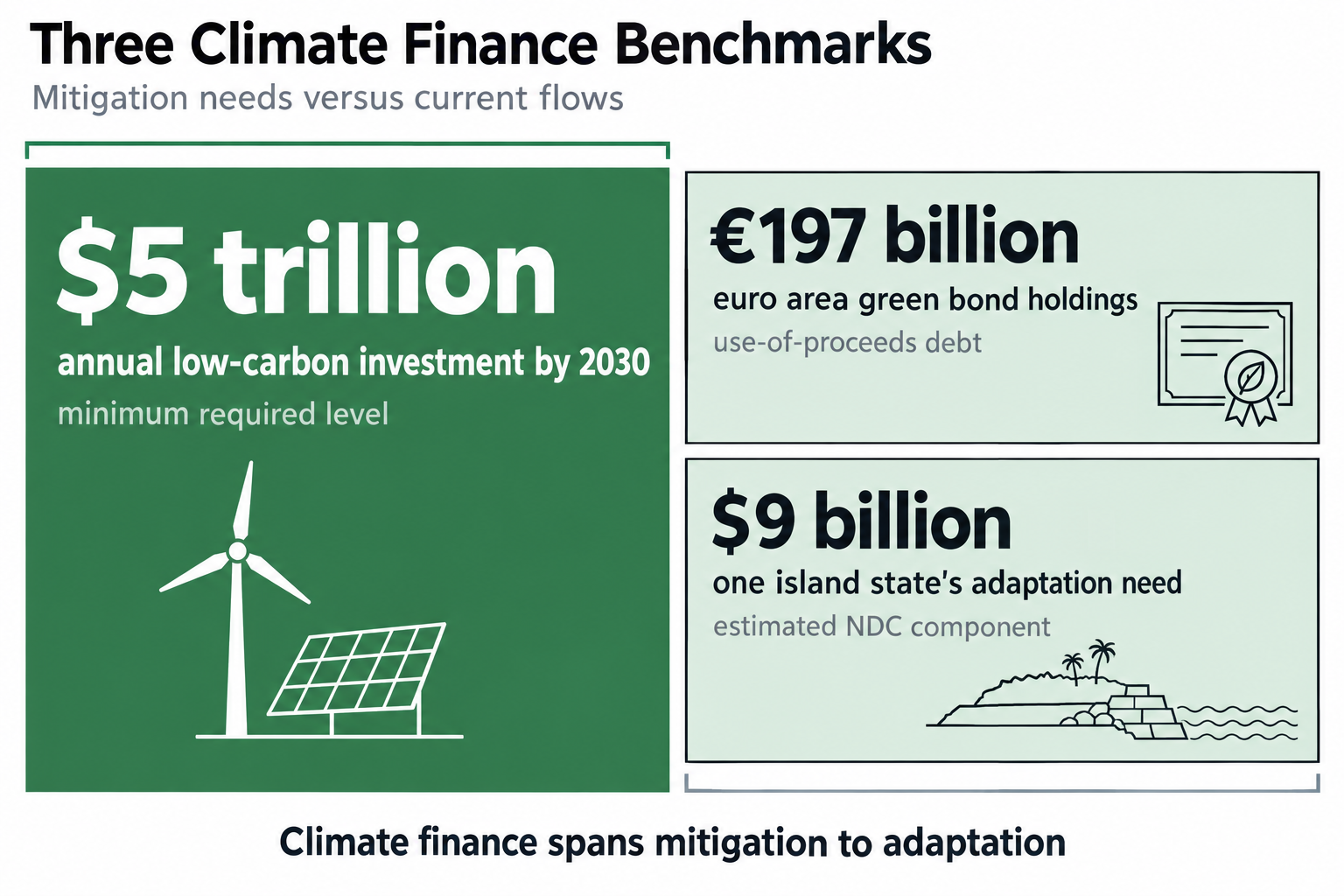
Scale matters for context. Citing the International Monetary Fund (IMF), the Yale School of the Environment notes that low-carbon investments must rise to more than $5 trillion annually by 2030 to reach net zero goals by 2050.
- Mitigation exposure: themes aimed at cutting emissions over time
- Adaptation exposure: themes aimed at handling climate impacts
- Risk lens: balancing transition risk and physical risk across holdings
- Time horizon: many climate themes play out over decades
- Reality check: climate allocations can be volatile and concentrated
Mitigation vs. Adaptation: Two Paths for Climate Investors
Most climate strategies split into mitigation and adaptation. In portfolio terms, transition risk is the risk of costs and value shifts driven by carbon pricing, regulation, technology change, and changing demand. Physical risk is the risk of damage to assets and supply chains from extreme weather and long-term climate shifts. Many mitigation assets are mainly exposed to transition dynamics, while adaptation spending is often a direct response to physical risk.
Nature-based mitigation is often framed as a carbon sink, not a technology substitute. The U.S. Climate Resilience Toolkit, citing the National Climate Assessment, describes land carbon storage (especially forests) as offsetting about 17% of annual U.S. emissions in its discussion of mitigation pathways. For a more specific accounting point, the EPA Inventory of U.S. Greenhouse Gas Emissions and Sinks: 1990–2022 reports that LULUCF offsets about 13% of gross U.S. greenhouse gas emissions over 1990–2022, and 14.5% in 2022. Because land sinks can reverse due to wildfire, pests, or land conversion, they may not be permanent emissions reductions.
Adaptation needs can be highly local, but still material. The Payne Institute for Public Policy reports that one small island developing state estimates it needs about $9 billion in investment to carry out the adaptation component of its Nationally Determined Contribution.
Mitigation
- Cuts or avoids emissions
- Driven by policy and cost curves
- Sensitive to technology disruption
- Often global and scalable
- Common in power and transport
Adaptation
- Reduces damage from impacts
- Often local and regulated
- Linked to resilience spending
- Sensitive to siting decisions
- Common in water and buildings
Which Climate Investment Vehicles Can You Choose?
Climate change investing shows up in multiple wrappers, from public funds to project finance. In fixed income, the European Central Bank notes that euro area investors held €197 billion of euro area green bonds in 2020. Green bonds are typically backed by the issuer’s balance sheet: investors take issuer credit risk, and repayment is not tied to a single project’s cash flows. In infrastructure and storage, developers such as Qnetic are working on flywheel-based long-duration storage for grids.
- Climate equity funds: diversified baskets with a climate theme
- Exchange traded funds: liquid exposure with index-style rules
- Green bonds: use-of-proceeds debt with issuer credit risk
- Carbon markets: policy-driven pricing of allowances
- Infrastructure and real assets: grids, efficiency, resilience, and storage
What Are Climate Investment Funds and ESG Strategies?
Climate investment funds are typically designed around climate risk or climate solutions, with explicit constraints and reporting. Environmental, Social, and Governance (ESG) strategies are broader and may include climate, but can also emphasize governance, labor, or controversy screens. The label alone does not tell you what you own.
Measurement can be unintuitive. The Kleinman Center for Energy Policy reports that firm size alone can explain about 30% of the variance in ESG scores in one scoring analysis, which raises questions about what some strategies are actually capturing.
Data sourcing also varies. The U.S. Securities and Exchange Commission notes that some ESG fund managers may rely on data from third-party providers when forming their strategies, which can lead to methodology differences across funds. As reference frameworks, you can look up the TCFD recommendations (created in 2015 by the Financial Stability Board) and the UN Principles for Responsible Investment when comparing how managers define risk, metrics, and stewardship.
- Exclusionary screening: removes sectors that conflict with constraints
- Best in class: tilts toward higher-scoring issuers
- Thematic climate: targets specific solution categories
- Active ownership: uses engagement and proxy voting
- Impact investing: targets measurable outcomes, often private
Comparing Climate Sectors: Where Energy Storage Fits
Once vehicles and fund labels are clear, sector choice often drives results. Energy storage can act as a mitigation enabler by shifting renewable output in time and supporting reliability as the grid decarbonizes, which is why long-duration energy storage is a recurring climate theme.
| Criteria | Renewable Generation | Adaptation Infrastructure | Carbon Markets | Long-Duration Energy Storage |
|---|---|---|---|---|
| Primary climate role | Mitigation | Adaptation | Mitigation incentive | Mitigation enabler |
| Main return driver | Power prices and capacity factors | Regulated returns and contracts | Policy and cap design | Reliability value and time shifting |
| Key risk to price | Interconnection and curtailment | Permitting and cost overruns | Rule changes and market design | Technology scale up and execution |
| Typical vehicles | Public equities and funds | Bonds and infrastructure funds | Allowances and funds | Infrastructure and project finance |
| Example fit | Developer and operator exposure | Resilience buildout exposure | Policy driven exposure | Qnetic is developing the Q500 flywheel unit at 500 kWh and 125 kW, designed for 3 hours at full power and 10+ hours derated |
Qnetic’s Experience With Long-Duration Storage Validation
For climate solutions, independent validation matters. Qnetic describes its path to commercialization through assessment programs and pilots, where performance claims are tested under real operating conditions before utilities commit to multi-decade deployments.
Independent validation and utility pilots for 2027
- Starting Point
- Utilities and developers need independent, standards-based evidence before committing to new storage hardware for decades of service. Early-stage data sheets and prototypes alone rarely justify grid deployments at scale.
- Approach
- Qnetic entered the Electric Power Research Institute (EPRI) technology assessment program, sponsored by the Sacramento Municipal Utility District (SMUD). EPRI is assessing the technology on behalf of eight leading utilities and developers, and Qnetic has shared its Vega prototype data package under a non-disclosure agreement (NDA).
- Result
- The assessment and scheduled pilots are planned rather than completed. Qnetic also reports non-binding letters of intent (LOIs) totaling $150M. Beta units are targeted for early 2027 on SMUD’s grid, with AI-grade duty-cycle testing planned from mid-2027 at the National Lab of the Rockies with Arevon.
How Qnetic Fits Into Long-Duration Energy Storage
Energy storage can sit inside climate change investing as a mitigation theme, especially where renewables need firming and time shifting. But sector selection also comes with technology scale up and execution risk. Qnetic states that for lithium-ion, degradation starts on Day 1, projects are often significantly overbuilt at commissioning, and useful life under normal duty is 7 to 10 years. Qnetic is pre-revenue, with pilots planned to start in 2027 and first deliveries planned from 2028, so this timing is exactly the execution risk investors weigh in long-duration storage. Many grid battery systems also limit operation to one cycle per day, which can constrain revenue. Qnetic positions its system as a mechanical battery that stores electricity as kinetic energy in a fast-spinning rotor rather than through electrochemistry.
- Multi-hour design: the in-development Q500 is designed for 3 hours at full power and 10+ hours derated
- Fast response: designed so the system responds in milliseconds
- Durability thesis: designed for 30 years with no capacity fade by design
Conclusion: A Practical Way to Start
Climate change investing is easiest to manage when you treat it as intentional portfolio construction. Start by deciding whether you are reducing climate risk, seeking return from solutions, or targeting measurable outcomes, then choose sectors based on how their risks are priced. With early-stage themes such as long-duration energy storage, that sector choice is inseparable from execution risk: validation, pilots, and scale-up can take years and may not go to plan. Whatever vehicle you use, do a practical due-diligence check by reading holdings and understanding data methodology, not just the fund label.
FAQ
What are climate investment funds?
Climate investment funds are portfolios built around climate solutions or climate risk management. They can use exclusions, tilts, or thematic selection, and may report emissions metrics. Holdings and methodology vary widely between funds with similar labels.
What are the top 5 companies to invest in right now?
There is no stable top five for climate investing because valuations, policy, and technology shift quickly. A common approach is to build diversified exposure across renewables, grids, efficiency, storage, and adaptation, then size positions to match your risk tolerance.
How much money has climate change cost?
There is no single agreed global total because studies count different categories. For a concrete data point, the National Oceanic and Atmospheric Administration’s National Centers for Environmental Information (NCEI) reports that the U.S. saw 28 separate billion-dollar weather and climate disaster events in 2023, totaling about $92.9 billion.
Is impact investing still a thing?
Impact investing remains common, especially in private markets where reporting can link capital to specific projects. The key is measurement clarity: define the outcome, the boundary, and the counterfactual, then report consistently over time.
How can investors spot greenwashing in climate funds?
Look for transparent holdings, a clear methodology, and repeatable reporting, not marketing claims. Check whether the strategy explains data sources and limitations, and whether performance is driven by a few large positions or a broad approach.
What role do green bonds play in portfolios?
Green bonds can fund eligible climate projects while still behaving like bonds in terms of duration and credit risk. They may suit investors who want climate-linked proceeds but prefer lower volatility than concentrated thematic equities.
Why is long-duration energy storage investable now?
As grids add more renewables, investors focus more on reliability and time shifting, not just generation. Long-duration storage is positioned as a mitigation enabler, and multiple technologies are competing to prove performance through pilots and assessments. One example is Qnetic’s Electric Power Research Institute (EPRI) assessment on behalf of eight leading utilities and developers, with beta units targeted for SMUD’s grid from early 2027.


