
Equity Crowdfunding for Founders and Investors
How to judge opportunities when liquidity is not guaranteed.

- What do investors actually own after investing online?
- Can non-accredited investors participate, and with what limits?
- What disclosures matter most before you invest?
- How long are equity crowdfunding shares typically locked?
- How do exits work without a public stock listing?
- What happens if the campaign target is not met?
- Equity crowdfunding is a regulated way to invest online in a private company by buying securities rather than backing a product or donation.
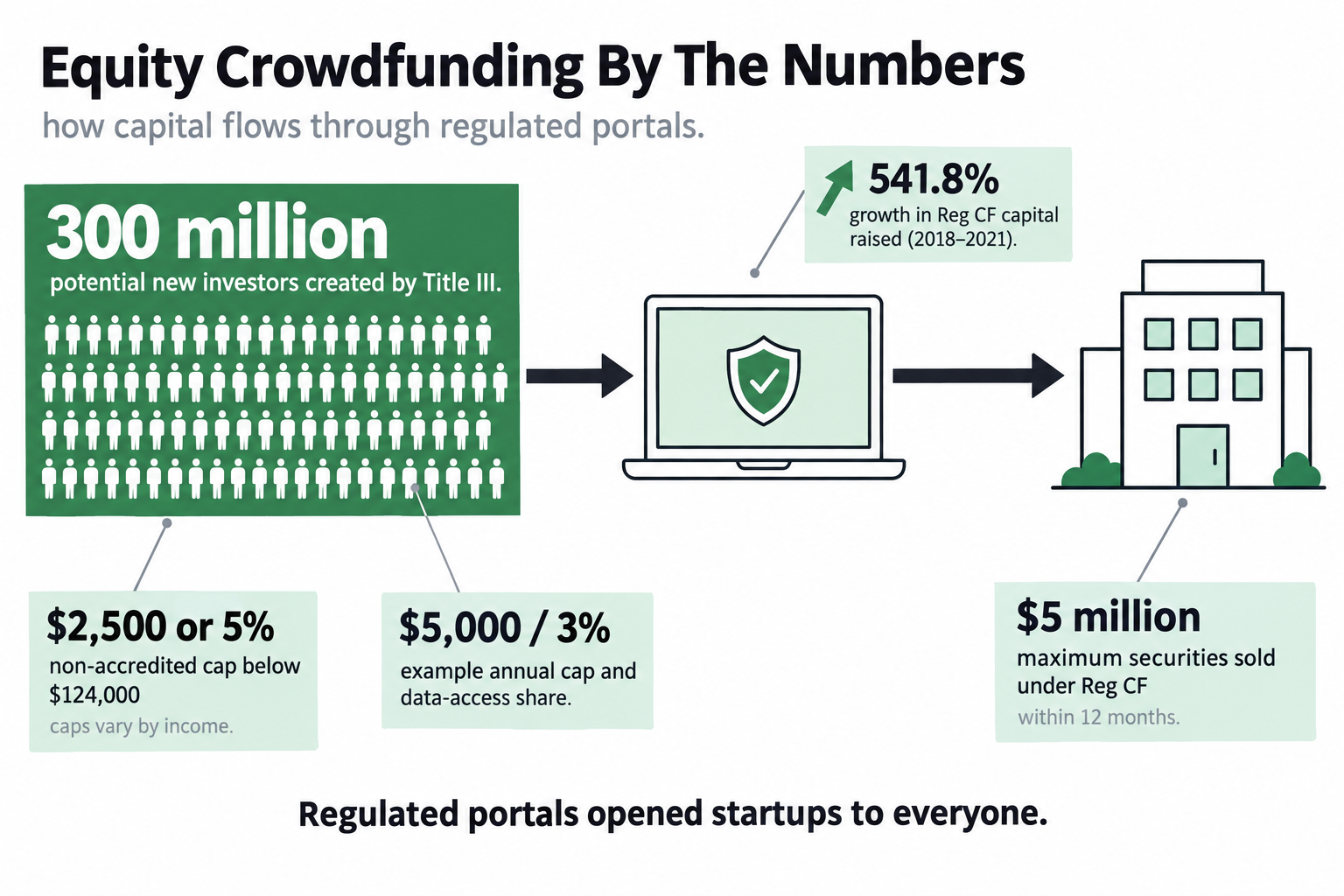
- In the United States, the U.S. Securities and Exchange Commission (SEC) says Regulation Crowdfunding (Reg CF) lets companies offer and sell up to $5 million of securities within any 12-month period without SEC registration.
- Equity crowdfunding is typically illiquid: even after a round closes, investors often need a later liquidity event such as an acquisition or buyback to realize value.
- For founders, equity crowdfunding can combine capital raising with community building, but it also brings ongoing reporting, compliance work, and a more complex shareholder base.
- One example is Qnetic, which is developing a grid-scale flywheel energy storage system with first deliveries planned from 2028. In deep tech, development and validation cycles can run for years.
- Equity Crowdfunding Starts With Ownership
- What Is Equity Crowdfunding?
- How Does Equity Crowdfunding Work?
- How Does It Differ From Donation and Rewards Crowdfunding?
- Which Regulations Govern Equity Crowdfunding?
- What Are the Benefits and Downsides of Equity Crowdfunding?
- Do You Have to Pay Back Equity Crowdfunding?
- Is Equity Crowdfunding Worth It for Founders and Investors?
- Conclusion: A Practical Way to Decide
Equity Crowdfunding Starts With Ownership
Equity crowdfunding looks like a campaign page, but it is a securities offering: investors contribute money and receive a stake in a private company. That difference drives everything that follows, from disclosure requirements and fees to resale limits and exit timelines.
If you are investing, the core risk is illiquidity: even after the round closes, you may not be able to sell for years. If you are raising, the tradeoff is compliance and ongoing reporting in exchange for access to many smaller investors.
What Is Equity Crowdfunding?
The term equity crowdfunding, also called equity-based crowdfunding, means a private company raises capital by selling shares or other securities online, so investors exchange money for an equity stake in the business. The U.S. Securities and Exchange Commission says Regulation Crowdfunding (Reg CF) provides an exemption that lets companies offer and sell up to $5 million of securities within any 12-month period without registering the offering with the SEC.
Equity crowdfunding lets a private company raise capital by selling securities online. Investors get ownership exposure and may benefit if a liquidity event occurs; dividends are possible but rare. Under Reg CF, offers run through an SEC- and FINRA-registered funding portal or broker-dealer.
- Securities: You buy an instrument such as stock or a note.
- Ownership exposure: Value depends on company performance over time.
- Valuation: Price per share sets the entry point.
- Dilution: Later funding rounds can reduce your ownership percentage.
- Information rights: Reporting is typically lighter than public markets.
- Time horizon: Outcomes often require an acquisition or initial public offering (IPO).
Because you are buying securities, equity crowdfunding is closer to venture-style investing than to backing a product launch. Returns tend to follow a skewed return distribution: most issuers fail, while a small number generate most gains.
How Does Equity Crowdfunding Work?
Campaign mechanics vary by exemption, but the flow is similar: an issuer prepares disclosures, lists the offering for investors – often via an intermediary portal (required for Reg CF) – and collects investor commitments online. For non-accredited investors, Reg CF investment limits apply across all Reg CF offerings in any 12-month period. Accredited investors (for individuals, generally those with more than $200,000 income – or $300,000 jointly with a spouse or partner – in each of the last two years; or net worth over $1 million excluding a primary residence; or a Series 7, 65, or 82 license) have no Reg CF investment limits.
-
Pick an exemption
Regulation Crowdfunding, Regulation A, or Regulation D. -
Set terms
Define security type, valuation, and target amount. -
Prepare disclosures
Explain risks, financials, and use of proceeds. -
Launch via portal (Reg CF)
Host the offer and communications on the portal. -
Investors commit funds
Review terms, ask questions, and subscribe. -
Target and escrow
Funds release only if the target is met. -
Close and report
Issue securities, then file required updates.
If the target is not met by the deadline, escrowed funds are returned to investors. Investors can cancel their commitment until 48 hours before the offering deadline.
How Does It Differ From Donation and Rewards Crowdfunding?
Donation and rewards crowdfunding are built around support and perks. Equity crowdfunding is built around securities, so the upside and downside are tied to the company’s long-term performance rather than product delivery.
| Model | What you receive | Why people contribute | Concrete example |
|---|---|---|---|
| Donation crowdfunding | No financial return | Support a cause or mission | Personal or nonprofit donation on a GoFundMe-style platform |
| Rewards crowdfunding | Product, perk, or early access | Get the reward if delivered | Texas Comptroller example: $25 T-shirt; $275+ unassembled Oculus Rift prototype |
| Equity crowdfunding | Securities such as shares | Investment upside if liquidity occurs | Small amount for common stock via a registered funding portal |
The key practical difference is that equity crowdfunding creates ongoing investor rights and legal obligations. Rewards campaigns are closer to commerce, while equity campaigns are closer to private-market investing.
Which Regulations Govern Equity Crowdfunding?
Equity crowdfunding is governed by securities law, so the rules depend on which exemption the issuer uses. In the U.S., Reg CF is the best-known route for retail participation, and it must be conducted through one intermediary: an SEC- and FINRA-registered funding portal or broker-dealer. Two common alternatives are Regulation A Tier 2 (up to $75 million in any 12-month period, open to non-accredited investors) and Regulation D Rule 506(c) (general solicitation allowed, sales only to verified accredited investors, and no dollar cap). For Regulation A and Rule 506(c), the SEC does not require an intermediary, and Regulation A can be run as a self-underwritten offering through the issuer’s own officers and directors.
This legal structure is also why access broadened quickly: the Library of Congress notes that Title III, also known as Regulation Crowdfunding, created 300 million potential new investors in the United States.
- Reg CF cap: Up to $5 million can be offered within any 12-month period.
- Investor limits: Per the SEC’s Investor Bulletin: Regulation Crowdfunding, over any 12-month period, non-accredited investors can invest up to the greater of $2,500 or 5% of the greater of annual income or net worth if either is under $124,000, or 10% of the greater of annual income or net worth if both are at least $124,000, capped at $124,000; accredited investors have no limits.
- Registered intermediaries: Reg CF offers run through regulated portals or broker-dealers.
- Disclosure package: Issuers share risks, terms, and financial information.
- Annual reporting: File Form C-AR within 120 days of fiscal year-end.
- Resale constraints: Reg CF securities generally cannot be transferred for one year.
Before investing, treat the exemption and disclosure set as part of the product. They shape the information you receive, the protections in place, and the realistic timeline to any secondary trading or exit.
What Are the Benefits and Downsides of Equity Crowdfunding?
Equity crowdfunding can be a funding and marketing tool that raises capital and can turn customers into shareholders, but it is still venture-style risk. A University of Colorado Law Review article reports 541.8% growth in capital raised via Regulation Crowdfunding between 2018 and 2021, which helps explain why more founders consider it.
Growth does not remove the downside: data published by the University of Colorado Law School notes that crowdfunding issuers are overwhelmingly early-stage companies with just a couple of employees and little to no revenue or assets. For investors, that means total-loss scenarios are a core part of the distribution.
For Founders
- Access capital without bank debt
- Turn customers into shareholders
- Public proof of traction
- Ongoing reporting and compliance
- Dilution and valuation pressure
- Complex cap table management
For Investors
- Low minimum entry sizes
- Early access to private deals
- Portfolio diversification potential
- High risk of total loss
- Illiquid securities for years
- Limited information versus public stocks
For founders, the main benefit is reaching many aligned supporters; the main downside is ongoing obligations that continue long after the campaign closes. For investors, the upside is access; the downside is a long holding period with uncertain outcomes.
Do You Have to Pay Back Equity Crowdfunding?
Equity crowdfunding can use different security types under Reg CF, including equity, debt notes, and convertible securities. If you buy equity such as common or preferred stock, there is usually no scheduled repayment of principal and interest, and investors benefit only if the security gains value and a liquidity path appears, such as an acquisition, dividends, or a buyback. If the offering is a debt note, the issuer repays principal and interest according to the offering documents; if it is convertible, the typical outcome is conversion into equity rather than a cash payout.
- Not debt (for shares): Companies are not making loan payments to equity investors.
- No guarantees: Returns depend on business outcomes, not promises.
- Liquidity events: Exits often take years and may never happen.
- Dividends: Possible, but uncommon for early-stage issuers.
- Loss risk: The investment can go to zero.
This is why position sizing matters: equity crowdfunding works best when it is one part of a diversified plan, not the core of a household’s liquid savings.
Is Equity Crowdfunding Worth It for Founders and Investors?
Whether equity crowdfunding is worth it depends on your role and constraints. A University of Colorado Law Review example notes that an investor permitted to invest $5,000 per year in Reg CF offerings would spend roughly 3% of that amount on a Kingscrowd subscription just to access data and insights, which can change the math for small portfolios.
- Investors: Expect high risk and a long time horizon.
- Diversification: Spread bets across multiple issuers, not one.
- Time horizon: Plan to hold for 5+ years if needed.
- Information check: Read the issuer’s Form C filed with the SEC.
- Use of proceeds: Verify where the money is going.
- Management compensation: Review pay to officers and directors.
- Transfer and voting: Check transfer restrictions and voting rights.
- Financials up to $1,235,000: First-time issuers can use reviewed statements.
- Repeat Reg CF issuer: Audited statements from the second offering.
- Financials above $1,235,000: Audited financial statements.
- Portal questions: Ask in the offering discussion channel.
- Founders: Use it when community building is strategic.
- Fundraise fit: Confirm the exemption limits match your plan.
Long product cycles are common in deep tech. Qnetic, for example, is developing a grid-scale flywheel energy storage system and expects first deliveries beginning in 2028. In practice, longer development timelines can mean long holding periods before any liquidity event is possible.
Conclusion: A Practical Way to Decide
Equity crowdfunding is best understood as online private-market investing under a defined exemption, where illiquidity is common and uncertainty is higher than in public markets. Before you commit, read the disclosure package carefully.
As an investor, commit only capital you can afford to lose and assume a 5+ year holding period. As a founder, use Reg CF only when its limits fit your raise target and the ongoing reporting workload is manageable.
FAQ
How does equity crowdfunding work?
Under Reg CF, a company posts a securities offering through an SEC- and FINRA-registered funding portal or broker-dealer, shares required disclosures, and collects investor commitments. If the funding target is reached, the round closes and securities are issued.
What are the downsides of equity crowdfunding?
The main downsides are high startup failure risk, limited liquidity, and fewer disclosures than public stocks. Investors can face dilution in later rounds and may be unable to sell for years.
Is equity crowdfunding worth it?
It can be worth it if you can diversify, hold for a long time, and afford a total loss. For founders, it can help raise capital and build a shareholder community.
Do you pay back crowdfunding?
Donation and rewards crowdfunding do not involve repayment; with rewards, backers do not receive cash repayment, and the creator owes delivery of the promised reward. Equity crowdfunding that sells shares does not require repayment, and investors benefit only if value is realized through an acquisition, buyback, or dividends. If the offering is a debt note, the issuer repays principal and interest according to the offering terms.
What do investors actually own after investing online?
Investors receive a security, often shares or a similar instrument, in a private company. The exact rights depend on the terms, including voting, dividends, and what happens in a sale.
How long are equity crowdfunding shares typically locked?
Under Reg CF, securities generally cannot be transferred for one year after the purchase date, except to the issuer, an accredited investor, as part of a registered offering, or to a family member or trust. After the one-year period, liquidity still depends on finding an eligible buyer and the security’s transfer terms; issuer consent may be required.
What happens if the campaign target is not met?
If a campaign does not reach its minimum target by the deadline, escrowed funds are returned to investors. Investors can cancel their commitment until 48 hours before the offering deadline.


