Long Duration Energy Storage: Technologies, Benefits, Tradeoffs
Duration, cycling, and asset life decide the best fit.

- How many hours qualify as long-duration storage?
- Which LDES technologies work at grid scale?
- How is LDES different from lithium-ion BESS?
- What does Levelized Cost of Storage mean for LDES?
- How often will an LDES plant fully cycle?
- Long-duration energy storage (LDES) is a category, not a single technology: the SLAC-Stanford Battery Center defines it as technologies that store energy over extended periods.
- A workable LDES strategy starts with the grid event you need to cover, then chooses duration, cycling, and asset life that match it.
- Pumped storage hydropower is the most mature long-duration option, while thermal, redox flow, sodium-ion, aqueous batteries, and kinetic systems target more flexible siting and scaling.
- Lithium-ion dominates deployed battery storage: the Clean Energy Institute at the University of Washington reports over 80% of more than 190 gigawatt-hours deployed globally through 2023.
- LCOS is lifetime cost divided by delivered energy, so the duty cycle sets how much energy is actually delivered. The Clean Energy Institute notes large-scale LDES needs costs significantly less than $100/kWh and more than 20 years of reliable service life.
- Why Multi-Hour Storage Is Now a Grid Requirement
- What Is Long-Duration Energy Storage (LDES)?
- How Does Long-Duration Energy Storage Work?
- Why Does the Grid Need LDES Now?
- What Are the Main LDES Technologies?
- LDES vs. Lithium-Ion Batteries: What Is the Difference?
- What Are the Benefits of Long-Duration Energy Storage?
- Challenges, Disadvantages, and Costs of LDES
- Can Long-Duration Energy Storage Make Money?
- Experience and Trust: Qnetic’s Independent Validation Path
- How Qnetic Designs a Multi-Hour Flywheel System
- Conclusion: Choosing LDES That Fits the Grid Event
Why Multi-Hour Storage Is Now a Grid Requirement
High-renewables grids can run into trouble when supply and demand stop lining up for hours at a time. Planners increasingly test portfolios against loss-of-load expectation (LOLE) targets such as one day in ten years, and a single long event can consume that reliability budget quickly.
That shift pushes storage decisions toward resource adequacy and away from one-size-fits-all “battery hours.” Start with the grid event you need to cover, then choose discharge duration that spans extended shortages of 10+ hours as well as multi-day events such as renewable droughts and cold snaps.
- Grid event: define the shortage window
- Duration: size hours as MWh ÷ MW
- Duty cycle: plan daily versus rare cycling
What Is Long-Duration Energy Storage (LDES)?
Definitions matter because a four-hour battery and a forty-hour plant solve different grid problems. The SLAC-Stanford Battery Center writes that “Long Duration Energy Storage (LDES) encompasses a range of technologies designed to store energy over extended periods.” In practice, many planners use 10 hours or more as a common baseline.
LDES is best understood as a duration category that also depends on duty cycle across many technology families. In planning terms, discharge duration is energy (MWh) divided by power (MW), as the sizing example below shows. Some systems are built to cycle frequently for daily shifting, while others exist mainly to cover rare, long events. The right definition is the one your market rules and reliability studies actually pay for.
- Duration baseline: often treated as 10+ hours
- Scope: includes multiple technology families
- Energy vs. power: duration is energy (MWh) ÷ power (MW)
- Use cases: daily shifting to multi-day reliability
- Terminology: LDES describes role, not chemistry
Long-duration energy storage (LDES) is energy storage built for 10+ hours of discharge, often extending into multi-day events to shift surplus generation into shortage periods.
How Does Long-Duration Energy Storage Work?
The operating logic is simple: charge when the grid has surplus energy or low prices, then discharge when the grid has shortage risk or high prices. In planning terms, duration equals energy (MWh) divided by power (MW): 400 MWh at 40 MW delivers 10 hours, while the same 400 MWh at 100 MW delivers 4 hours.
Because long events are what matter, system evaluation often focuses on availability, how the system holds energy between charge and discharge, and whether performance stays stable across years of operation. Those details determine whether a design can credibly provide reliability across long gaps and repeated cycling.
- Charge: absorb surplus generation or low-price energy
- Store: hold energy across multi-hour gaps
- Dispatch: deliver during scarcity and peak net load
- Support: provide grid services where market rules allow
- Track: measure efficiency, availability, and cycling profile
Why Does the Grid Need LDES Now?
Three pressures stack together. Variable generation is rising, load is changing faster, and high-impact weather can stretch shortages across days. The hardest periods can last well beyond the evening peak. At the same time, new large loads can add volatility to demand profiles.
McKinsey modeling for the Long Duration Energy Storage Council suggests there is potential to deploy 1.5 to 2.5 TW of long-duration storage by 2040—roughly 8 to 15× the global storage capacity installed as of 2021—with $1.5 to $3 trillion of investment implied. Policy is starting to reflect that scale; Virginia SB 448 (April 2026) mandates 4.5 GW of long-duration storage by 2045, defined as storage with at least 10 hours of duration. Grid operators also care about what repeated cycling does to assets. Some applications, such as AI data centers, can create fast load fluctuations that are better buffered by systems designed for high cycling without capacity fade. That pushes procurement toward technologies that pair long duration with robust lifetime economics.
- Renewable variability: output gaps can last multiple hours
- Curtailment: surplus energy is wasted without storage
- Weather risk: long events outlast short backup solutions
- Load growth: new demand can reshape peak periods
- Transmission limits: local storage can reduce congestion exposure
What Are the Main LDES Technologies?
LDES is a portfolio decision, so teams typically compare technologies by storage medium, siting constraints, and how independently power and energy can scale. The SLAC-Stanford Battery Center highlights major LDES research across sodium-ion batteries, aqueous batteries with water-based electrolytes, and redox flow batteries known for flexible scaling of power and energy.
Alongside those electrochemical approaches, pumped storage hydropower remains the most established long-duration option, while thermal storage and kinetic flywheel systems aim to expand siting and cycling flexibility. The best fit depends on the grid event you need to cover and the market revenue available.
| Technology class | How it stores energy | Typical strengths | Typical constraints | Where it fits best |
|---|---|---|---|---|
| Pumped storage hydropower | Water moved between reservoirs | Mature at large scale, long asset life | Site and permitting limits | Bulk shifting and regional adequacy |
| Thermal storage | Heat stored, then converted back | Low-cost materials, long holds possible | Conversion losses and integration complexity | Long holds where efficiency is acceptable |
| Sodium-ion batteries | Electrochemical storage with sodium-based materials | Materials can be more abundant | Commercial maturity varies by design | Multi-hour applications as the technology matures |
| Aqueous batteries | Electrochemical storage with water-based electrolytes | Safety and sustainability advantages | Performance depends on chemistry and balance-of-plant | Multi-hour stationary storage where safety is prioritized |
| Redox flow batteries | Electrolytes stored in external tanks | Power and energy can scale separately | Balance-of-plant cost and complexity | Daily shifting with longer durations |
| Kinetic flywheel systems | Rotational kinetic energy in a rotor | High cycling capability, no thermal runaway | Engineering complexity and early deployments for LDES | High-utilization multi-hour cycling and hybrids |
LDES vs. Lithium-Ion Batteries: What Is the Difference?
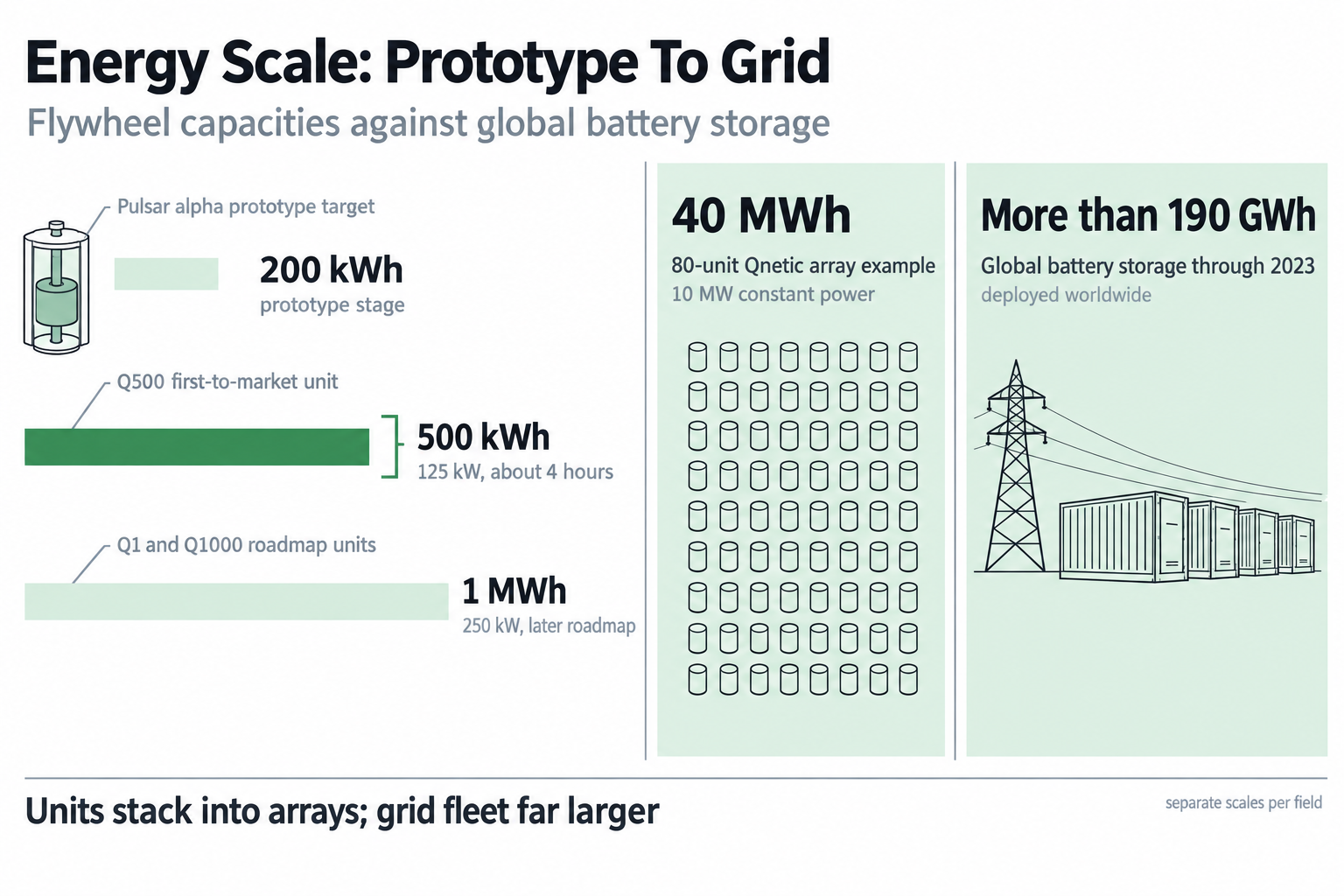
Many buyers start with lithium-ion because it is widely deployed and well understood. The Clean Energy Institute at the University of Washington notes that lithium-ion batteries account for over 80% of the more than 190 gigawatt-hours (GWh) of battery energy storage deployed globally through 2023. That dominance does not mean lithium-ion is the best fit for every long-duration duty cycle.
The practical difference is lifecycle behavior and economics. Lithium-ion battery energy storage systems (BESS) tend to excel at short-duration, high-efficiency response, but long-duration needs can run into degradation, repowering schedules, and cycling constraints. LDES options aim to extend discharge duration and align asset life with grid infrastructure timelines.
Long-Duration Systems
- Designed for 10+ hours to multi-day
- Covers extended shortages and renewable droughts
- Value depends on scarcity and capacity payments
- Often deeper cycles, sometimes less frequent
- Finance hinges on long service life
Lithium-Ion BESS
- Fast response for peaks and ramps
- High efficiency in many operating points
- Degradation and repowering affect lifetime economics
- Supply chain and safety require controls
- Fade starts on Day 1; 7-10 years useful life under normal duty
What Are the Benefits of Long-Duration Energy Storage?
Benefits only matter when they match a real grid constraint. In long-duration procurement, the highest-impact benefits are usually reliability coverage during extended shortages, reduced curtailment of renewables, and the ability to replace fossil peakers during long scarcity windows. Events like Winter Storm Uri in Texas in February 2021 showed how a multi-day cold snap can lead to rotating blackouts when firm supply runs short. The exact value depends on siting, interconnection, and how the market pays for availability.
These benefits matter most during extended scarcity events, like Winter Storm Uri, that last for days.
Grid resilience
Covers multi-hour outages and renewable droughts.
Decarbonization
Reduces reliance on fossil peakers.
Curtailment reduction
Stores surplus solar and wind generation.
Capacity value
Supports adequacy during long scarcity events.
Siting flexibility
Helps where transmission expansion is slow.
Safety profile
Avoids thermal runaway in non-chemical designs.
A useful checkpoint is consistency: buyers will check asset life, maintenance, and the replacement cycle alongside any long-duration claim.
Challenges, Disadvantages, and Costs of LDES
LDES projects fail less often on theory than on execution. Cost, permitting timelines, and market design are the biggest blockers, and each technology class has its own bottlenecks. The Clean Energy Institute at the University of Washington states that large-scale, long-duration energy storage requires costs significantly less than $100/kWh and more than 20 years of reliable service life, far cheaper than today’s best battery technologies.
Those constraints force hard tradeoffs: civil works and permitting can dominate pumped hydro, conversion losses can dominate some thermal routes, and newer electrochemical systems can face bankability hurdles. Even with a strong technical fit, interconnection and contracting can decide whether a project actually gets built.
- Capital cost: long duration can mean high upfront spend
- Permitting: siting and environmental review can extend schedules
- Efficiency: lower round-trip efficiency can erase arbitrage margin
- Revenue risk: markets may not pay for rare long events
- Technology risk: newer designs need bankable field data
- Interconnection: queue delays can dominate the calendar
Can Long-Duration Energy Storage Make Money?
LDES makes money when its physical capability matches what the market pays for, and when the project is actually dispatched often enough to earn. For daily shifting, planning typically assumes about one full cycle per day, while reliability-only assets may fully cycle only a few times per year. And power limits revenue: a 40 MW / 400 MWh plant cannot discharge faster than 40 MW into a price spike, even if prices are extreme. Levelized Cost of Storage is informative only when the duty cycle assumption is realistic.
Qnetic positions its economics around avoiding capacity fade by design and enabling the freedom to cycle more than once a day, depending on market opportunity. It presents those claims as projections until they are independently validated.
- Energy arbitrage: earn on price spreads when they exist
- Capacity value: get paid for being available in peaks
- Ancillary services: provide reserves where qualified by rules
- Congestion relief: capture location-driven value at constraints
- Utilization: cycling frequency drives delivered lifetime energy
Projected, not measured: Qnetic projects up to 3.4× more lifetime energy traded than a comparable lithium iron phosphate (LFP) battery over a 30-year project life, driven by no capacity fade by design and the freedom to cycle more than once a day.
Experience and Trust: Qnetic’s Independent Validation Path
Utilities rarely buy on claims alone, especially for assets expected to operate for decades. Qnetic emphasizes independent validation through the Electric Power Research Institute (EPRI) and utility-hosted pilots before wider deployment, with results scheduled rather than already published.
Independent validation and utility pilots for 2027
- STARTING POINT
- A grid-scale storage technology needs standards-based proof on a live utility grid before utilities commit multi-decade budgets. Data sheets and lab claims rarely carry a procurement decision without independent protocols and comparable operating data.
- APPROACH
- Qnetic entered EPRI’s independent technology assessment program, sponsored by Sacramento Municipal Utility District (SMUD). EPRI evaluates the technology on behalf of eight leading utilities and developers that represent more than 40,000 MW of future demand, alongside two utility-scale pilots scheduled for 2027.
- RESULT
- The first SMUD beta units are targeted for early 2027, and AI-grade duty-cycle testing with Arevon at the National Lab of the Rockies is targeted from mid-2027. These milestones are scheduled and not yet supported by published field results.
How Qnetic Designs a Multi-Hour Flywheel System
Grid planners increasingly look for storage that can cover multi-hour gaps without taking on degradation and repowering cycles that shape lithium-ion BESS economics, with degradation starting on Day 1, projects significantly overbuilt at commissioning, and a useful life of seven to ten years under normal duty. They also look for designs that avoid a one-cycle-per-day limit when the market rewards more frequent cycling. For reference, NREL’s 2024 Annual Technology Baseline uses a 15-year financial lifetime for lithium-ion, which depends on augmentation spending to hold nominal capacity.
Against that problem frame, Qnetic positions its system as a grid-capable mechanical battery that stores electricity as rotational kinetic energy. The company is developing the Q500 as its first commercial product target, designed for 500 kWh of capacity at 125 kW, about 3 hours at full power, and 10+ hours at derated power. Many planning definitions treat LDES as 10+ hours, so the Q500 meets that threshold only at derated power (10+ hours) and does not imply performance for multi-day events. A later roadmap unit is planned in the 1 MWh class.
At the prototype level, Qnetic describes the completed Vega prototype at 20 kWh and 10 kW and the Pulsar alpha target at 200 kWh. For grid-scale sizing, Qnetic describes modular arrays where multiple units are interconnected; an example configuration is 80 units that deliver 30 MWh at 10 MW full power and a further 10 MWh at reduced power, for 40 MWh in total. Across its product narrative, Qnetic states a round-trip efficiency range of roughly 80 to 88% and an idle holding time of more than 15 days.
- Storage medium: kinetic energy in a rotor, not electrochemistry
- Core enablers: carbon fiber rotor, magnetic bearings, vacuum chamber
- Performance targets: roughly 80 to 88% round-trip efficiency range
- Hold behavior: more than 15 days idle holding time
- Roadmap clarity: Q500 first, 1 MWh class unit later
- Scaling approach: arrays combine units into grid-scale blocks
Conclusion: Choosing LDES That Fits the Grid Event
LDES is a family of approaches that should be matched to the grid event you need to cover and the revenue mechanism that pays for that coverage. Many planners treat 10 hours of discharge as a baseline. And as the Clean Energy Institute at the University of Washington notes, large-scale LDES economics typically require costs well under $100/kWh and more than 20 years of reliable service life. Use Levelized Cost of Storage as a duty-cycle metric: lifetime cost divided by delivered energy, where cycling determines how much energy is actually delivered.
FAQ
What will replace lithium batteries in the future?
In some roles, lithium-ion may be complemented by pumped hydro, thermal storage, flow batteries, sodium-ion, or mechanical systems. The replacement depends on duration and cycling needs, plus safety, siting, and supply-chain constraints.
What are the disadvantages of BESS?
A battery energy storage system can face thermal runaway risk, capacity fade, and shorter asset life that forces repowering. Warranty limits on cycling and temperature can also reduce revenue or increase operating complexity.
What is the longest lasting energy source?
There is no single “longest lasting” energy source, because lifetime depends on refurbishment and operating conditions. For storage assets, pumped hydro and some mechanical approaches are built around multi-decade service targets.
How many hours count as long-duration storage?
A common baseline is 10 hours or more of discharge at rated power, because it goes beyond the four-hour battery norm. In planning studies, the same label can extend to multi-day reliability coverage.
What are the three types of energy storage?
One practical grouping is mechanical, thermal, and electrochemical storage. Each category can include long-duration designs, but they differ in round-trip efficiency, siting limits, and how easily power and energy capacity scale independently.
What does LCOS mean for LDES projects?
Levelized Cost of Storage (LCOS) spreads lifetime cost over delivered energy, so duty cycle matters. A low LCOS estimate does not help if the market does not pay for availability or scarcity-hour discharge.
How often will an LDES plant fully cycle?
It depends on the use case: daily time-shifting is often planned around about one full cycle per day. Technologies without a one-cycle-per-day limit can cycle more often when market spreads support it. Reliability coverage for rare multi-day events may only fully cycle a few times per year, which then shapes what revenues are realistic.