Large Scale Battery Energy Storage Systems: How They Work
Definitions, operation, grid value, cost drivers, and safety basics

- What size makes a BESS utility scale today?
- How does storage reduce peak demand without peakers?
- Which components matter most inside a grid-scale facility?
- What usually drives LCOS more than capex?
- How do flow batteries compare with lithium-ion on duration?
- Large scale battery energy storage systems are grid-connected assets sized by power (MW) and energy (MWh), with duration in hours defining how long they can sustain output.
- A Battery Energy Storage System (BESS) charges during surplus periods and discharges during peaks, using inverters and controls to follow dispatch while protecting the cells.
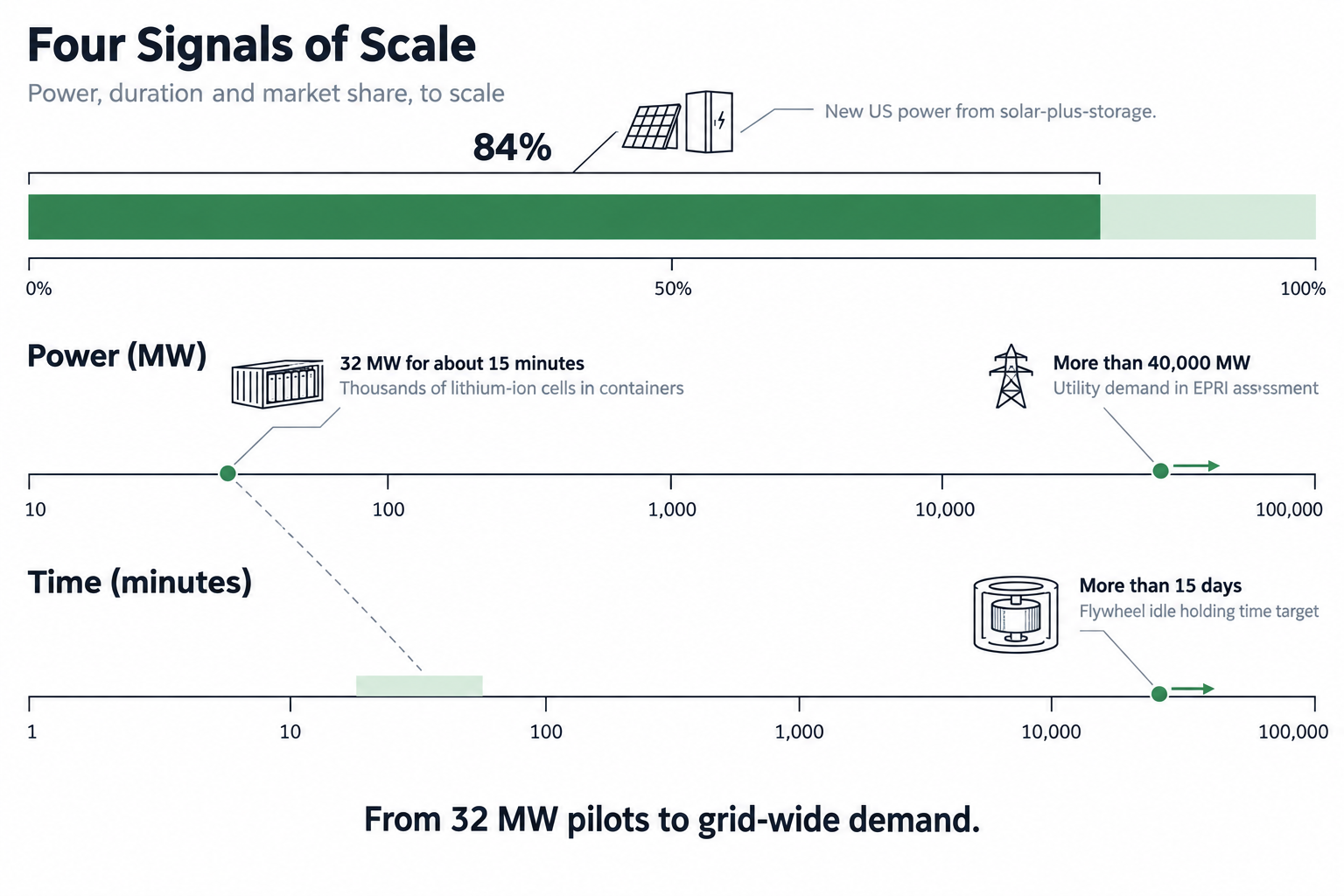
- Wired described an early grid-scale project that delivered 32 megawatts for about 15 minutes, illustrating how design points have shifted from minutes to multi-hour operation.
- Costs are driven as much by interconnection, civil works, and operating profile as by the battery packs, which is why Levelized Cost of Storage (LCOS) often differs from upfront capex.
- SEIA and Wood Mackenzie reported that solar plus storage accounted for 84 percent of new US generating capacity added in 2024, signaling how quickly storage is becoming standard grid equipment.
- Grid Storage Is Becoming Critical Infrastructure
- What Are Large-Scale Battery Energy Storage Systems?
- How Do Grid-Scale Battery Storage Facilities Work?
- Why Does Large-Scale Storage Matter for the Grid?
- Which Technologies Are Used for Large-Scale Energy Storage?
- What Do Large-Scale Battery Storage Systems Cost?
- What Are the Safety Risks and Limitations?
- What Is the Future of Large-Scale Energy Storage?
- Qnetic Utility Validation Roadmap
- How Qnetic Fits Non-Chemical Grid Storage
- Conclusion
Grid Storage Is Becoming Critical Infrastructure
As wind and solar grow, grids need a way to keep steady power flow when generation swings. The U.S. Environmental Protection Agency explains that battery energy storage systems help stabilize electrical grids by providing steady power flow despite fluctuations from inconsistent generation of renewable energy sources.
At scale, dispatchable storage can shift energy across hours, smooth volatility, and support reliability without running fossil generation just to cover short ramps.
- Sizing: power (MW) and energy (MWh) solve different problems.
- Value streams: arbitrage, capacity, and grid services pay differently.
- Technology choice: lithium-ion, flow, and mechanical storage behave differently.
- Lifetime economics: cycle limits and replacements can dominate outcomes.
- Safety case: hazard controls shape layout, permits, and operations.
What Are Large-Scale Battery Energy Storage Systems?
A Battery Energy Storage System (BESS) becomes “large-scale” once it stops behaving like a backup device and starts behaving like grid infrastructure. In practice, that means megawatts of power, megawatt-hours of energy, and an interconnection that lets the operator follow dispatch instructions from a utility or market.
Large-scale BESS are grid-connected storage plants rated in MW and MWh that provide peak shifting and fast grid support. Many new solar-plus-storage projects use four-hour duration as a reference design point.
- Power rating: sets how fast the site can discharge.
- Energy capacity: sets how long output can be sustained.
- Duration: links MW and MWh into hours of delivery.
- Interconnection: ties the plant into a substation or node.
- Inverters: synchronize DC storage with AC grid needs.
- Controls: manage dispatch, limits, and protective actions.
In procurement, the term large scale energy storage system usually points to a front-of-meter asset with market and reliability duties, not a building-level backup solution. Many grid-scale sites are now built at tens to hundreds of megawatts, paired with multi-hour energy capacity.
How Do Grid-Scale Battery Storage Facilities Work?
Once storage is treated as dispatchable infrastructure, the operating loop becomes predictable: forecast, charge, hold, discharge, and verify performance. In a grid-scale battery storage facility, controls coordinate power conversion, protection, and metering so the asset can follow instructions without overstressing equipment.
-
Forecast and schedule
Optimize charge windows using prices and constraints -
Charge the system
Convert grid AC into battery DC -
Store energy in cells
Store energy electrochemically (lithium ions in anode) -
Monitor and hold
Track temperatures, voltages, and state of charge -
Discharge to the grid
Convert DC back to synchronized AC -
Settle and report
Meter output for settlement and compliance
Wired described an early grid-scale battery project built by AES Energy Storage that involved thousands of lithium-ion cells in storage containers that together combined to provide 32 megawatts of power and deliver it for about 15 minutes. Many modern installations target longer discharge windows, but the same operational loop still applies.
In that same forecast-to-settlement loop, Qnetic is developing a flywheel-based mechanical battery that replaces the “store” step with kinetic motion in a vacuum chamber. The company states design targets of roughly 80 to 88% round-trip efficiency and an idle holding time of more than 15 days.
Why Does Large-Scale Storage Matter for the Grid?
Storage matters because it gives grid operators a controllable lever: absorb excess energy, inject power when supply drops, and respond fast to stability needs. Large-scale battery energy storage systems also reduce reliance on peaker plants by shifting energy into high-demand hours instead of burning fuel to cover short spikes.
- Renewable firming: reduce curtailment by shifting output in time.
- Peak shaving: discharge into high-price, high-demand periods.
- Fast response: stabilize the grid within seconds when needed.
- Congestion relief: ease constraints at lines and substations.
- Resilience support: improve recovery options after outages.
The same asset can stack multiple services, but the dispatch profile you choose affects cycling, wear, and lifetime economics. In practice, value depends on nameplate MW and MWh, the duty cycle, and how the plant is dispatched.
Which Technologies Are Used for Large-Scale Energy Storage?
Grid services can be delivered by different storage physics, and the tradeoffs show up in degradation, safety case, siting constraints, and lifetime economics. Batteries for large scale energy storage are still dominated by lithium-ion for many applications, but other technologies compete where duration and asset life dominate the business case.
| Technology | What it does best | Typical limitations | What to check |
|---|---|---|---|
| Lithium-ion BESS | Fast response and mature supply chains | Degradation and safety case complexity | Thermal management, warranties, duty-cycle limits |
| Flow batteries | Longer duration by scaling electrolyte tanks | Footprint and system complexity | Round-trip efficiency, pump losses, maintenance model |
| Pumped storage hydropower | Large energy capacity over long durations | Geography and permitting constraints | Site feasibility, environmental approvals, build time |
| Compressed air storage | Bulk shifting where geology fits | Location dependence and efficiency tradeoffs | Storage cavern design, integration, operating profile |
| Flywheel storage (generic) | High power and frequent cycling | Energy duration varies by design | Containment, bearing design, vibration control |
| Qnetic kinetic battery | Non-chemical multi-hour shifting as a design target | In development, pilots planned | Targets: 3 hours at full power, 10+ hours derated; more than 15 days idle holding time |
For a broad overview of technology options, the U.S. Department of Energy provides resources covering many storage categories, including Pacific Northwest National Laboratory’s 2020 Grid Energy Storage Technologies Cost and Performance Assessment.
What Do Large-Scale Battery Storage Systems Cost?
Installed costs for large-scale battery storage include far more than the battery modules, especially once you account for interconnection, power conversion hardware, and civil works. Levelized Cost of Storage (LCOS) is commonly used to compare systems over time because it reflects losses and replacements, not just upfront spend.
Installed BESS: ~$125-$334 per kWh (NREL 2025 benchmark near the upper end).Li-ion pack: $115/kWh average (BloombergNEF, December 2024).Important distinction: pack pricing is only one component of installed cost.
- Battery packs: chemistry, packaging, and warranty terms.
- Inverters: conversion equipment sized to MW power.
- Transformers: voltage steps and grid compliance hardware.
- Civil works: foundations, enclosures, drainage, access.
- Interconnection: studies, protection, and upgrades.
- Operations: monitoring, maintenance, and availability.
Two projects with similar MW and MWh can end up with very different lifetime costs once you account for how often they cycle, how much energy is lost to conversion, and what components must be replaced to keep delivering contracted performance.
What Are the Safety Risks and Limitations?
Safety and permitting determine whether a project can be built and operated at all. The Electric Power Research Institute notes that any form of stored energy poses some hazard, because energy that is stored has the potential for release in an uncontrolled manner, potentially endangering equipment, the environment, or people. In the U.S., project teams commonly align designs and reviews with NFPA 855, and many procurement specs reference UL 9540 and UL 9540A.
- NFPA 855: U.S. installation standard for stationary ESS.
- UL 9540: system-level safety certification.
- UL 9540A: test method for propagation behavior.
- Thermal events: heat and off-gassing can escalate quickly.
- Electrical hazards: high-voltage switching and arc flash risks.
- Ventilation: manage heat and potential off-gases.
- Gas and fire detection: early warning and alarms.
- Remote monitoring: continuous telemetry and fault alerts.
- Firefighter coordination: coordinated plans, training, and access.
- Operating limits: aggressive dispatch can shorten useful life.
A grid-scale battery storage installation also carries non-battery risks, including transformers and switchgear. Mechanical storage shifts the hazard profile: Qnetic states its approach avoids thermal runaway and that its carbon-fiber rotor is designed to fail benignly, with below-grade siting, a vacuum chamber, magnetic bearings, and a safety bearing system providing layered protection; formal UL 9540 certification has not yet been completed.
What Is the Future of Large-Scale Energy Storage?
One way to quantify the next phase is the scale of demand: McKinsey modeling for the Long Duration Energy Storage Council estimates a global need of 1.5 to 2.5 terawatts of long-duration storage by 2040, roughly 8 to 15 times the storage capacity installed in 2021, requiring $1.5 to $3 trillion of investment. New load shapes, including AI data centers, add value to storage assets that can respond quickly and cycle frequently without rapid loss of usable capacity.
- Longer duration: more projects target multi-hour shifting and beyond.
- Hybrid plants: combine fast response with durable energy capacity.
- Better utilization: value stacking becomes the default business case.
- More disclosure: financiers push for clearer lifetime assumptions.
- Non-chemical options: mechanical approaches gain attention where fit matters.
In other words, the “best” system is defined by the duty cycle, safety case, and lifetime cash flow it can support, not by a single headline number.
Qnetic Utility Validation Roadmap
Multi-decade grid assets are purchased on evidence. Qnetic’s public plan emphasizes third-party assessment and live-grid pilots as scheduled milestones, with pilots planned for 2027 and initial deliveries planned from 2028.
Independent Validation and Utility Pilots
- STARTING POINT
- Utilities need standards-based evidence for a storage asset expected to operate for decades. A data sheet alone cannot cover dispatch profiles, fault cases, and lifetime economics.
- APPROACH
- According to Qnetic, Qnetic entered the Electric Power Research Institute independent technology assessment program, sponsored by Sacramento Municipal Utility District. EPRI validates the technology on behalf of eight leading utilities and developers that represent more than 40,000 MW of future demand.
- NEXT MILESTONES
- The next milestones are scheduled, not yet running: beta units on SMUD’s Sacramento grid from early 2027, and AI-grade duty-cycle testing with Arevon at the National Lab of the Rockies from mid-2027.
How Qnetic Fits Non-Chemical Grid Storage
If you need multi-hour shifting but worry about capacity fade, the design objective changes. Qnetic is developing a flywheel energy storage system that stores energy mechanically as kinetic motion, aiming to avoid lithium and cobalt and to reduce replacement-driven lifetime cost.
- Mechanical storage: energy is stored in a spinning rotor in vacuum.
- Wear control: magnetic bearings avoid contact and lubrication.
- System scaling: Q500 units are designed to form arrays.
Qnetic publishes its own LCOS modeling as a projection rather than a measured field result, and it separates that in-house modeling from Imperial College London’s independent 2030 benchmark figure discussed in its materials.
Conclusion
With solar plus storage accounting for 84% of new US power added in 2024, large-scale storage is becoming standard grid equipment. Technology selection should match the duty cycle, safety case, and lifetime economics the project needs to deliver.
FAQ
What is considered utility scale BESS?
Utility-scale Battery Energy Storage System (BESS) usually means a front-of-meter, grid-connected project starting around 1 MW. Many modern sites are tens to hundreds of MW with multi-hour duration.
What is Elon Musk’s new battery?
There is no single officially defined “Elon Musk’s new battery.” Tesla’s grid storage product is Megapack, which uses lithium-ion cells. Tesla also promotes 4680 cells, but the chemistry remains lithium-ion.
What are the biggest energy storage companies?
Depending on whether you count cells, system integrators, or project owners, large names include Tesla, CATL, BYD, LG Energy Solution, and Fluence. Rankings vary by region, project size, and reporting method.
How is energy stored in a lithium-ion battery?
A lithium-ion battery stores energy chemically. During charging, lithium ions move into the anode structure; during discharge, they move back. Electrons travel through the external circuit to deliver power.
What is the difference between power and energy ratings?
Power (MW) is how fast a storage plant can deliver electricity at a moment. Energy (MWh) is how much it can deliver over time. Dividing MWh by MW gives duration in hours.
What is LCOS and why does it matter?
Levelized Cost of Storage (LCOS) estimates the average lifetime cost per delivered megawatt-hour, accounting for capex, efficiency losses, and replacements. It matters because a low upfront price can still mean high lifetime costs.
What makes long-duration storage different from four-hour BESS?
Long-duration storage is designed to discharge for many hours, covering long renewable gaps and evening peaks. Non-chemical options are emerging too: Qnetic is developing a flywheel system targeted at 3 hours at full power and 10+ hours at derated power.