
Data Center Energy Storage Market: Size, Technology and Trends
Why AI-driven power demand makes storage a core piece of every data center strategy.

- Do data centers really need energy storage today?
- How big is the data center energy storage market?
- Which storage technology best suits AI data centers?
- What drives growth in data center storage demand?
- Which benefits does storage bring to data center operators?
- The data center energy storage market reached about $6.0 billion in 2025 and is forecast to hit $63.8 billion by 2034, a compound annual growth rate of 30 percent.
- AI workloads are the main trigger: US data center consumption is set to double or triple by 2028 according to the Department of Energy’s Berkeley Lab report, pushing operators toward large-scale storage for reliability.
- Lithium-ion dominates today, but flow and flywheel systems gain ground because they avoid the degradation, fire risk and short cycle life that limit conventional batteries.
- Storage cuts energy costs, shortens grid interconnection queues by years and secures uninterrupted power — three benefits that decide whether a data center scales or stalls.
- Qnetic is developing a flywheel system designed for zero degradation across a 30-year life, targeting a lifetime cost of $101/MWh against $164/MWh for lithium-ion by 2030 — with utility pilots scheduled from 2027.
- What is the data center energy storage market?
- Why do data centers even need energy storage?
- How big is the data center energy storage market?
- Which storage technologies do data centers use?
- What drives the growth of the market?
- Which benefits does storage bring operators?
- Who are the leading providers in the storage market?
- Our experience with data center storage validation
- How Qnetic solves the data center storage problem
- Conclusion: storage decides how fast data centers scale
What is the data center energy storage market?
The data center energy storage market covers every system that buffers power for a data center, from rack-level UPS batteries to grid-scale on-site installations. It is expanding because computing has run into an energy wall: AI training and cloud services pull power in fast, uneven bursts, and aging grids struggle to keep up. Storage sits in between, smoothing those swings and keeping critical loads online.
One theme runs through it all: rising demand creates a storage problem, and the technology an operator picks determines how well that problem gets solved. The gap is not marginal — Qnetic, which builds grid-scale kinetic storage, estimates that a full renewable transition needs roughly 100 times today’s installed grid storage capacity, and argues that energy, not compute, is becoming AI’s real bottleneck.
Why do data centers even need energy storage?
Yes, data centers need energy storage, and the reason is timing. The grid delivers steady power, but AI racks draw loads that spike and drop within seconds. Liquid-cooled AI racks can pull over 120 kW each, eight times a standard rack. Storage absorbs those swings, so servers see clean, uninterrupted power even when the grid is stressed or curtailed.
The pressure is measurable. The US Department of Energy’s Berkeley Lab report puts data center consumption at 176 TWh in 2023, or 4.4 percent of US electricity, and projects 325 to 580 TWh by 2028 — a doubling to tripling in five years. McKinsey looks further out and sees data centers at 11 to 12 percent of US power demand by 2030. On top of that sits grid infrastructure often over 60 years old.
- Ride-through power: bridges brief grid interruptions without downtime
- Load smoothing: buffers high-frequency AI spikes and drops
- Backup supply: keeps critical systems running during outages
- Grid independence: reduces reliance on constrained utility feeds
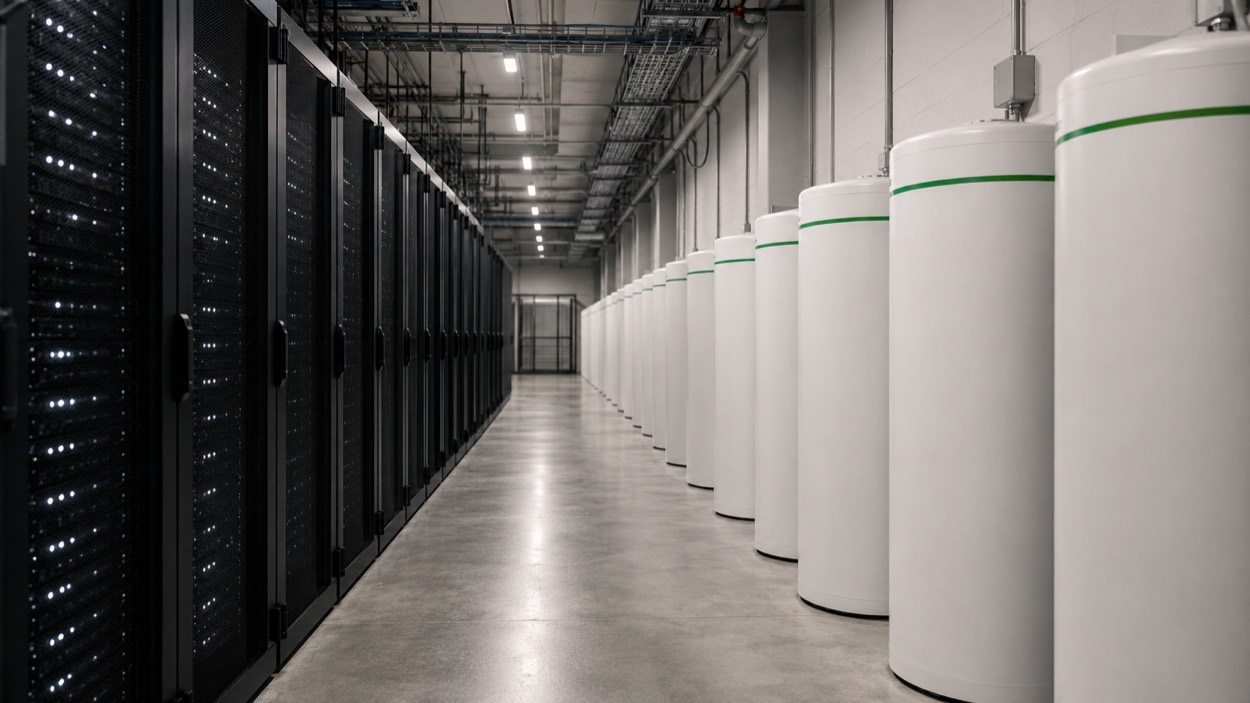
How big is the data center energy storage market?
The data center energy storage market was worth about $6.0 billion in 2025 and is projected to grow to $63.8 billion by 2034, according to the AI Data-Center Grid-Connected Energy Storage Market Research Report (Energy & Power). That equals a compound annual growth rate of 30 percent across the forecast period — a far steeper trajectory than the broader battery storage market, and a sign of how concentrated demand is becoming around AI-driven data center loads.
Regionally, North America stays the largest market, carried by heavy data center construction, while Asia-Pacific grows fastest thanks to rapid digitalization. This is exactly the window in which newer entrants can win position. Qnetic, a deep-tech company building grid-scale storage, estimates a US serviceable market of $300 billion by 2050 and around $3 trillion globally — figures that show why capacity is being built now.
- 2025 size: roughly $6.0 billion
- 2034 forecast: $63.8 billion at 30 percent CAGR
- Leading region: North America by installed volume
- Fastest grower: Asia-Pacific driven by digital buildout
Which storage technologies do data centers use?
Data centers choose between several storage families, and each trades off lifetime, safety and discharge duration differently. Lithium-ion leads on energy density and cost today, yet degradation and fire risk push operators to compare alternatives. Flow batteries scale well for long duration, and flywheel systems store energy mechanically without chemical wear. The table below sets the main options side by side, including how Qnetic positions its flywheel.
| Technology | Lifetime | Safety | Discharge duration |
|---|---|---|---|
| Lithium-ion | 14–16 years, degrades over time | Fire / thermal runaway risk | 1–4 hours |
| Lead-acid | Short, frequent replacement | Stable, well understood | Short-term backup |
| Flow (vanadium) | Long, lower efficiency (~65%) | Non-flammable electrolyte | 4–12 hours |
| Flywheel (generic) | Long, low energy density | No fire risk, mechanical | Seconds to hours |
| Qnetic flywheel (pre-commercial, pilots from 2027) | 30 years, zero degradation | Intrinsically safe, no thermal runaway | 4–12 hours, 85% RTE |
What drives the growth of the market?
Several forces are driving storage adoption at the same time, and no single one drives the trend alone.
AI power demand
AI workloads compress the storage timeline by a decade.
Renewable integration
Solar and wind need storage to stay stable.
Declining costs
Cheaper cells make storage a stronger investment.
Regulatory support
Mandates like Virginia SB 448 require long-duration storage.
Grid constraints
Aging infrastructure forces on-site buffering.
Which benefits does storage bring operators?
Storage delivers several gains at once, and operators weigh them together rather than in isolation.
Lower energy cost
Buy power when cheap, discharge when expensive.
Faster interconnection
Cut years off grid queue timelines.
Uptime security
Ride through outages without service loss.
New revenue
Earn from frequency regulation and ancillary services.
These benefits are where Qnetic focuses its AI-grade storage design: a hybrid setup in which the flywheel absorbs high-frequency AI spikes with sub-3-millisecond response while lithium-ion handles bulk duration — an arrangement that also extends the battery system’s own lifetime.
Who are the leading providers in the storage market?
The data center energy storage market is led by large industrial and battery firms. Named players include Schneider Electric, Siemens, General Electric, Tesla, Eaton, ABB, LG Chem, Samsung SDI, and Fluence. Most supply lithium-ion battery energy storage systems, while UPS remains the backbone for short-term backup and BESS handles longer grid support.
On who supplies energy to data centers, the honest answer is layered: the utility grid remains the primary source, increasingly backed by on-site solar, natural gas, and stored energy. That storage layer is where challengers enter. Qnetic competes here with a degradation-free flywheel aimed at operators frustrated by lithium-ion cycle limits and replacement cost.
- Established players: Schneider Electric, Siemens, ABB, Eaton
- Battery specialists: Tesla, LG Chem, Samsung SDI, Fluence
- Emerging category: flywheel and long-duration entrants like Qnetic
Our experience with data center storage validation
“Early in my career, I worked on one of the world’s first efforts to commercialize flywheel energy storage. That experience gave me a deep appreciation for the technology’s unique strengths.” — Hugh McDermott, CCO & President Americas at Qnetic. That perspective shapes how the company proves its technology in real conditions, not on paper.
Validation runs on two tracks. The Sacramento Municipal Utility District will be piloting Qnetic systems and EPRI has been formally engaged to validate the and publish standard test results from the pilot.
The second track targets data centers directly: from mid-2027, the National Lab of the Rockies will run Qnetic units against emulated AI data center load profiles.
How Qnetic solves the data center storage problem
Lithium-ion loses capacity every year and limits daily cycles, which caps the revenue and reliability a data center can plan around. Qnetic removes that ceiling. Its kinetic battery stores energy mechanically in a carbon-fiber rotor on magnetic bearings, so nothing degrades and nothing burns.
- Zero degradation across a 30-year design life — no costly mid-life replacement
- Unlimited daily cycling — a projected 3.4× more traded energy over that lifetime
- $101/MWh target lifetime cost — about 38% below lithium-ion by 2030
Operators evaluating storage for AI loads can start with Qnetic‘s free AI-Grade Energy Storage whitepaper to compare the numbers directly.
Conclusion: storage decides how fast data centers scale
The data center energy storage market is growing because power, not compute, has become the real bottleneck for AI. Data center demand doubles to triples by 2028, the storage market roughly triples by 2035, and the technology an operator chooses shapes cost, uptime and grid access for decades. Lithium-ion still leads, but its degradation and cycle limits open room for flow and flywheel systems.
For operators, the practical move is to compare storage on lifetime cost and cycling, not just upfront price. Qnetic addresses exactly that gap with a degradation-free, fire-safe flywheel built for AI-grade duty cycles — a concrete alternative worth putting into any storage shortlist.
FAQ
Do data centers need energy storage?
Yes. Storage buffers AI load spikes, bridges grid interruptions and secures uptime for critical systems. Qnetic supports this with a flywheel storage system designed specifically for the fast, uneven power profiles of AI data centers.
What is the biggest supplier of energy to data centers?
The utility grid remains the primary supplier, increasingly backed by on-site solar, natural gas, and battery or flywheel storage. Storage systems act as the buffer that keeps grid power stable and continuous for demanding computing workloads.
Who are the big 5 in data centers?
By operating capacity, the biggest names are the four US hyperscalers — Amazon, Microsoft, Google and Meta, with roughly 19.4 GW of self-built IT capacity between them in early 2026 and including Equinix, the largest colocation operator, which represents about 3 GW. On the storage side that keeps those facilities stable, the leading suppliers are Schneider Electric, Siemens, ABB, Eaton and Tesla.
How big is the data center energy storage market?
The data center energy storage market reached roughly $6.09 billion in 2024 and is forecast at $17.71 billion by 2035, a 10.19 percent CAGR. Qnetic targets this space with grid-scale, long-duration flywheel storage.
Which storage technology is best for data centers?
It depends on duration and risk tolerance. Lithium-ion suits short backup, flow batteries handle long duration, and flywheel systems handle the spiking load changes while simultaneously avoiding degradation and fire risk entirely, making them strong for repeated daily cycling under AI loads.
How does storage lower data center energy costs?
Storage enables energy arbitrage — buying power when cheap and discharging when prices peak. It also avoids demand charges through peak shaving and can earn revenue from frequency regulation and other ancillary grid services.
Is flywheel storage suitable for data centers?
Yes. Modern flywheels reach 4–12 hour discharge without degradation or fire risk. Qnetic’s kinetic battery delivers sub-3-millisecond response and a 30-year lifetime, making it a practical fit for AI-grade data center duty cycles.


